
Give “Come, You Thankful People” One Clear Invitation
Holiday & Special Occasion Music
By Spiritrax Content Studio · October 7, 2026
Updated October 7, 2026
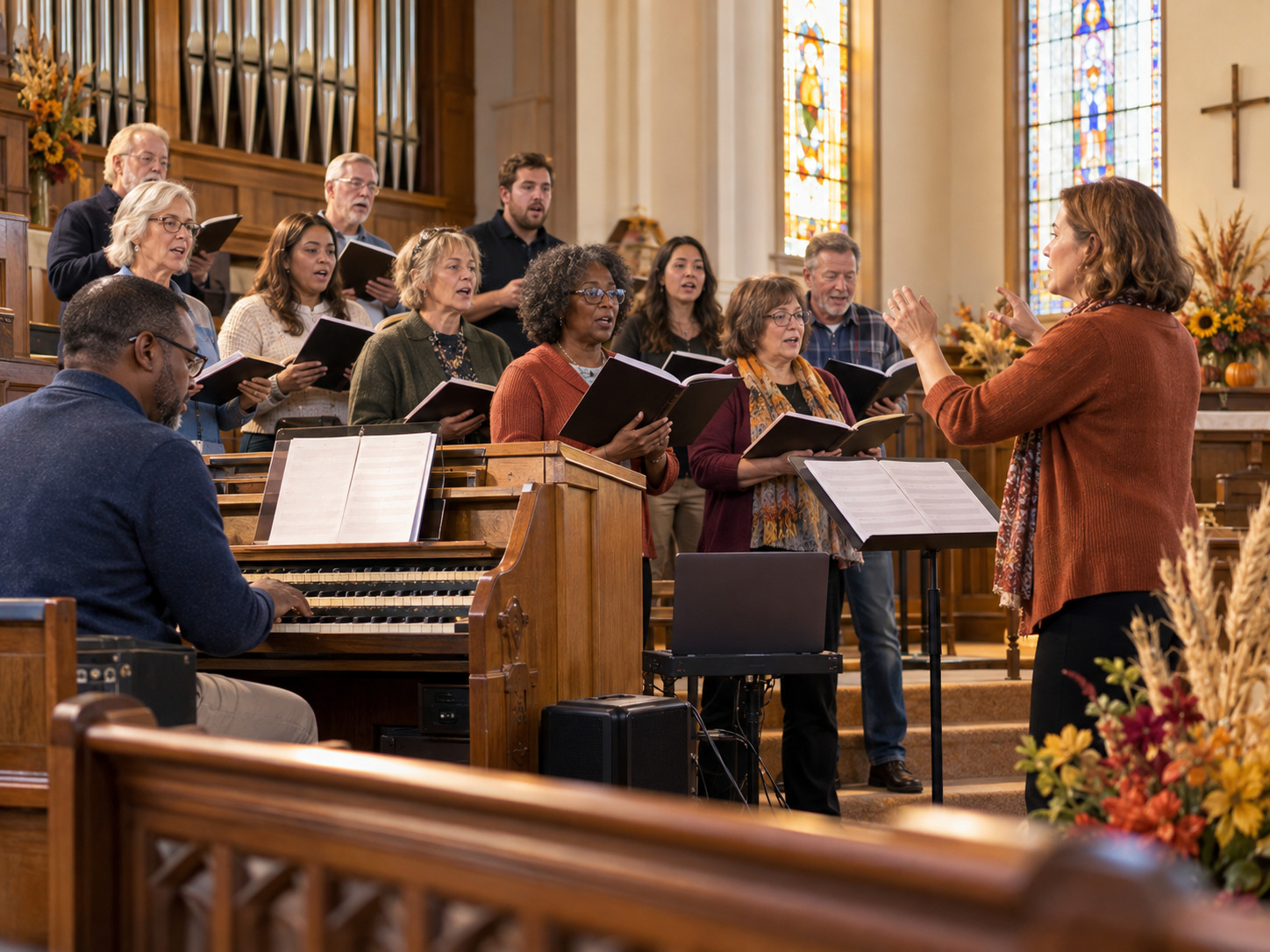
The short answer: choose the key with the people who will actually sing, rehearse the organ introduction as a real cue, and give each verse a clear leader. “Come, You Thankful People, Come” works best when the congregation can enter confidently and carry the words without chasing the accompaniment.
Spiritrax offers a traditional solo-organ backing track for “Come, You Thankful People, Come” in F, E-flat, and B-flat major. That gives a worship leader three practical starting points for a Thanksgiving service, harvest observance, choir feature, or congregational hymn.
Decide who is carrying the hymn
Before choosing a key, name the primary singers:
- the full congregation;
- a choir that invites the congregation to join;
- a soloist or cantor;
- or a small group leading a service without a live organist.
The same track can serve each setting, but the rehearsal priorities change. A congregation needs a comfortable range and unmistakable entrance. A choir needs shared consonants and verse transitions. A soloist needs breath, phrasing, and space for the text. A volunteer-led service needs simple playback cues that do not depend on guesswork.
Write that job into the service plan before rehearsal. “Thanksgiving hymn” is a category. “Choir leads verse one; congregation joins on verse two” is an executable plan.
Compare F, E-flat, and B-flat with real voices
Do not select the key from a printed range or one singer’s first phrase. Preview all three available versions and test the people who will lead.
Use this sequence:
- Sing the opening phrase in F, E-flat, and B-flat.
- Continue into a later verse, when voices are less fresh.
- Test the final phrase and cadence in each realistic option.
- Listen for comfortable sustained notes, clear words, and confident unison.
- Choose the version the room can carry without strain or loss of energy.
The lowest option is not automatically the most congregational. If the melody sits too low, people may stop projecting and the text can lose clarity. If it sits too high, untrained voices may press or drop out. The useful key is the one that keeps the center of the melody singable for the actual congregation.
If none of the three versions fits, listen to the complete arrangement and identify the specific range or structural need before requesting a customization. A precise request is more useful than “make it easier.”
Treat the organ introduction as an invitation
An organ-led track establishes the room quickly. The introduction should give singers enough information to hear the key, feel the pulse, and prepare the first breath.
Rehearse the opening from silence:
- Who introduces the hymn?
- Who presses play?
- When does the spoken introduction end?
- Who gives the visible breath?
- Can the congregation see the lyrics or hymnal before the first note?
- Is the organ track audible without feeling abrupt?
Run that edge more than once. A familiar hymn can still begin uncertainly when the speaker talks over the introduction or the leader breathes after the track has already established the entrance.
One person should own the visible cue. When a choir director, worship leader, and soloist all gesture differently, the congregation hesitates even if the accompaniment is steady.
Give every verse a job
The product page presents multiple verses of the hymn. Do not make the only plan “repeat and get louder.” Decide how leadership and participation develop.
One possible structure is:
| Verse | Leader | Rehearsal purpose |
|---|---|---|
| 1 | Choir or worship leader | Establish key, tempo, and first entrance |
| 2 | Choir with congregation | Invite confident shared singing |
| 3 | Smaller texture or selected voices | Restore text clarity and contrast |
| 4 | Full group | Return with a settled final statement |
This is a planning example, not a required order. A congregation that knows the hymn may sing from the beginning. A choir feature may keep more of the musical responsibility. The useful principle is that every change in participation should be deliberate and visible.
Mark who gives the breath at each verse, whether the congregation remains standing or seated, and how the next verse begins. The track will keep its own time. The leaders need to make that timing feel hospitable rather than mechanical.
Keep the words ahead of the volume
Organ accompaniment can fill a sanctuary without much effort. Begin by setting the live voices and microphones. Then add enough track for people to hear the key, pulse, verse transitions, and cadence.
Listen from the seating area and check:
- whether the first word of each verse is audible;
- whether lower voices disappear under the organ;
- whether sustained vowels stay unified;
- whether final consonants release together;
- whether the accompaniment remains supportive when the room joins;
- and whether the last cadence feels complete without excessive volume.
If singers begin forcing, lower or reposition the playback before asking for more vocal effort. A full organ sound can feel confident at a moderate level when the voices remain clear.
Let the tempo serve the text
A harvest hymn can become heavy if every phrase is treated as a ceremonial statement. It can also feel rushed if the accompaniment pulls singers through long sentences without a shared breath plan.
Speak one verse together at the track’s pulse. Mark where the thought continues across a line and where the group truly needs to breathe. Then sing the verse without adding extra pauses that the fixed track cannot support.
Use the organ rhythm to keep the hymn moving, but do not let the beat flatten the text. Leaders should agree on:
- the important word in each phrase;
- where consonants must arrive together;
- how long final sounds can be sustained;
- and when the release belongs to the track rather than an extra conducting hold.
The goal is not perfect uniformity. It is enough agreement that the congregation hears one invitation instead of several competing interpretations.
Place the hymn inside the service
Thanksgiving music can serve as gathering, response, offering, reflection, or sending. The placement determines how much explanation and musical energy the moment needs.
For a gathering hymn, make the first entrance immediate and welcoming. For an offering or reflection, keep the playback level restrained enough that the text leads. For a sending hymn, let the final verse carry confidence without turning into a race.
Spiritrax’s broader Thanksgiving worship-music plan can help place this hymn inside a complete service arc. Use the song-specific rehearsal to solve key, entrances, verse leadership, and playback; use the larger plan to decide what the rest of the service needs.
Avoid a long spoken introduction that makes people forget the tempo and first note. One clear sentence about when to join is usually enough.
Rehearse the ending and the next moment
The final cadence is not finished until the next service action is clear. Decide:
- who releases the choir or congregation;
- whether a moment of silence follows;
- whether prayer, scripture, an offering cue, or dismissal comes next;
- and when the next speaker begins.
Run the final verse into that transition with the actual playback device, microphones, and leader. Do not fade the track early unless that choice has been rehearsed and is appropriate to the approved recording and service plan.
The sound volunteer should have one approved filename, the chosen key, the start cue, the volume starting point, and a note describing what follows the final sound. Keep a backup copy on a second device.
A 20-minute rehearsal plan
Minutes 1–4: compare the keys
Test F, E-flat, and B-flat with the intended leaders, including a later verse and the final phrase.
Minutes 5–8: prove the first entrance
Run the spoken introduction, playback start, organ introduction, visible breath, and first phrase.
Minutes 9–12: assign the verses
Write who leads each verse and exactly when the congregation joins.
Minutes 13–16: balance words and organ
Sing through the actual microphones and speakers. Listen from the congregation area.
Minutes 17–20: rehearse the final handoff
Run the last verse, final cadence, release, and next spoken or musical service moment.
Final checklist
- F, E-flat, and B-flat were compared with the actual leaders.
- The selected key works for a later verse as well as the opening.
- The spoken introduction ends before the musical cue needs attention.
- One person owns the visible first breath.
- Every verse has a clear leader and participation plan.
- The congregation knows when it is invited to join.
- Phrase breaths and final consonants were rehearsed.
- Organ playback supports the words without covering them.
- The final cadence and next service moment were tested together.
- The approved file is labeled clearly and backed up.
- Any customization request names a tested key, range, tempo, or structural need.
- Lyric display, livestream, recording, and sound-recording permissions were checked separately as applicable.
FAQ: “Come, You Thankful People, Come” backing tracks
Which keys does Spiritrax offer?
The product page lists F major, E-flat major, and B-flat major.
What kind of arrangement is it?
Spiritrax describes the recording as a traditional solo-organ accompaniment.
Should the choir or congregation begin?
Either can work. If the room needs help hearing the key and tempo, let the choir or worship leader establish the first entrance before the congregation joins on a clearly named verse.
How loud should the organ track be?
Loud enough for singers to hear the key, pulse, transitions, and cadence, but not so loud that the words or lower voices disappear. Set live voices first and listen from the seating area.
What should the playback volunteer know?
Provide the exact filename, selected key, start cue, volume starting point, verse-participation plan, ending, and the service action that follows.
The strongest final test is whether an ordinary person in the room can hear the introduction, take one confident breath, and stay with the hymn through the final cadence. When the key, leadership, and service handoffs are settled, the organ track can support gratitude without turning the moment into a performance exercise.
Preview F, E-flat, and B-flat major, then choose the organ-backed version your choir, soloist, or congregation can carry with confidence.
Preview the Three Keys