
A Choir Sectional Should Make Every Part More Independent
Planning Guides
By Spiritrax Content Studio · September 3, 2026
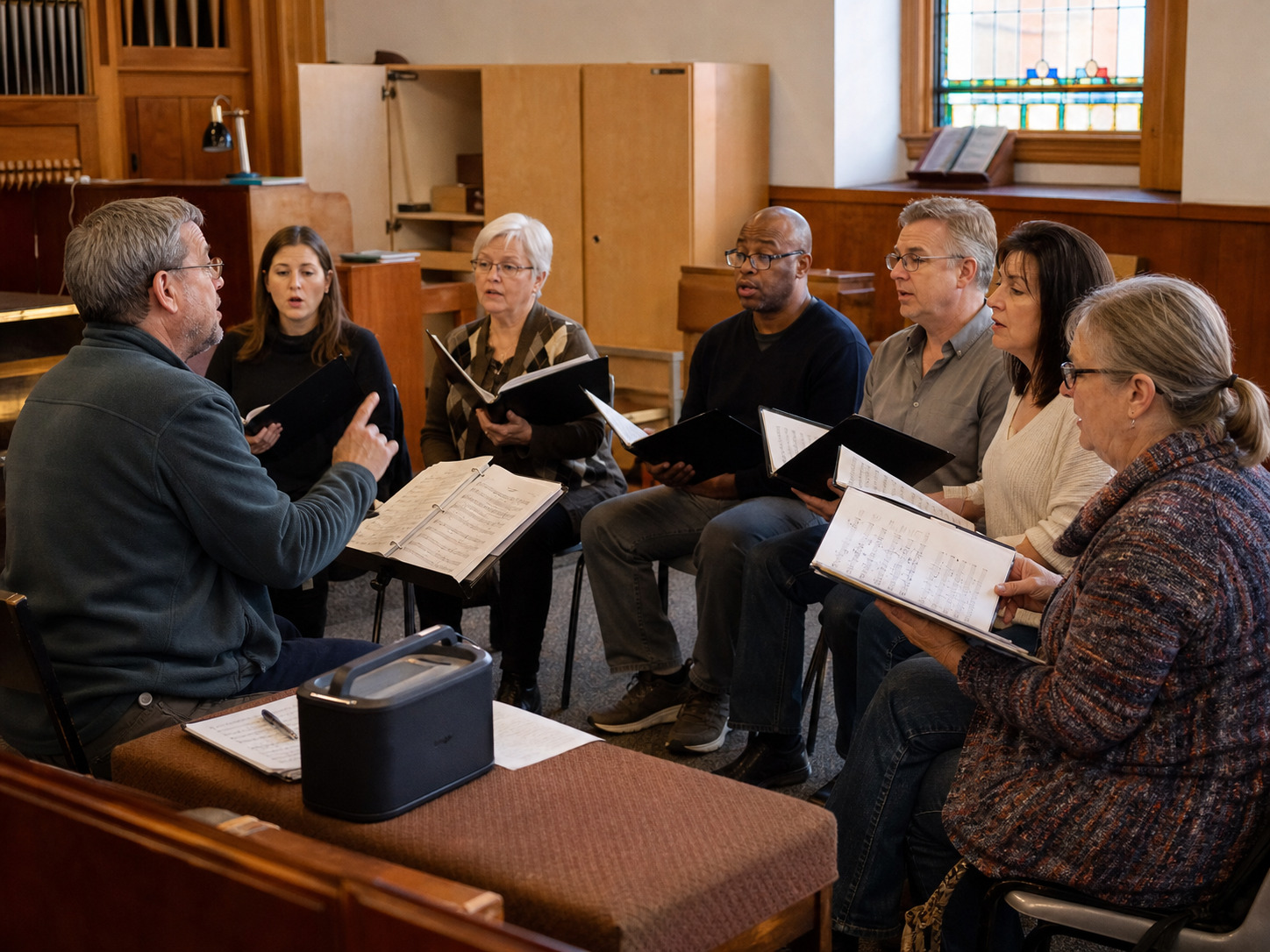
The short answer: a church-choir sectional should help one voice part hear, repeat, and remember its own musical work well enough to return to the full choir with less dependence on the director or neighboring singers.
Backing tracks and guide-vocal demonstrations can make that work more focused when a pianist is unavailable, rehearsal time is limited, or several sections need to practice at once. The key is to give each file one job: teach the part, establish the accompaniment, or test whether singers can carry the music independently.
A sectional should not become forty-five minutes of singing along with a louder recorded voice. It should move singers from support toward ownership.
Decide what the section must be able to do alone
Start with an observable goal.
By the end of the sectional, should the singers be able to:
- enter after the introduction without a spoken count;
- hold their notes against a different voice part;
- sing a difficult interval accurately;
- remember the rhythm of a repeated phrase;
- shape one long line together;
- pronounce the same consonants and vowels;
- follow a cut, repeat, or verse plan;
- or sing the complete number with accompaniment only?
“Learn the song” is too broad for one rehearsal block. Choose one or two outcomes, then select the recording and repetition pattern that serve them.
Use guide vocals and accompaniment for different jobs
A guide-vocal demonstration is useful when singers are first learning melody, rhythm, diction, or form. An accompaniment-only track is the better test of whether they can carry those decisions themselves.
| Rehearsal need | Best starting file | What to do next |
|---|---|---|
| Learn the melody or rhythm | Guide-vocal demonstration | Sing short phrases, then reduce dependence on the recorded voice |
| Hear the complete form | Guide vocal or full demonstration | Mark verses, repeats, cuts, and transitions |
| Practice entrances | Accompaniment track | Stop before each entrance, give the starting pitch, then let singers enter from the recording |
| Test independence | Accompaniment track | Run without the director singing the part |
| Prepare for the service | Final accompaniment track | Rehearse the exact key, intro, verses, ending, and cue plan |
The Spiritrax guide to guide vocals versus backing tracks for choir rehearsal explains the transition in more detail. The practical principle is simple: use the demonstration to teach, then remove that support before the sectional ends.
Choose a room and playback level that let singers listen
Sectionals do not need a perfect studio. They do need enough separation and clarity for singers to hear their own section.
Set up the room so that:
- everyone can see the section leader;
- the track is audible without covering the singers;
- the speaker is not directly beside one person's ear;
- printed or digital music is easy to follow;
- starts and stops can happen quickly;
- and another sectional cannot overwhelm the room.
Keep the playback level lower than a performance mix. If singers can only stay together when the guide vocal is louder than they are, the recording is masking the next rehearsal need.
Use a 45-minute church-choir sectional plan
Adjust the length for your choir, but keep the sequence purposeful.
Minutes 0–5: establish the musical map
Name the exact song, arrangement, key, file, and service use. Mark the verses, repeats, cuts, introduction, ending, and any place where the director or worship leader will cue the choir.
Do not spend the first minutes distributing several versions. Everyone should know which musical plan is being learned.
Minutes 5–12: listen for the part's job
Play the relevant section once without asking everyone to sing immediately.
Listen for:
- where the part enters;
- whether it carries melody, harmony, rhythm, or sustained support;
- which words align with another section;
- where breath is shared;
- and what changes at the next verse, chorus, or ending.
Ask one or two concrete questions. “What note do we enter on after the introduction?” is more useful than “Did everyone get it?”
Minutes 12–25: learn in short phrases
Use the guide vocal or a capable section leader to teach one manageable phrase at a time.
For each phrase:
- listen;
- speak the rhythm or text if needed;
- sing on a neutral syllable when pitch is the problem;
- add the words;
- connect it to the next phrase;
- and repeat from the musical entrance, not only from the first difficult note.
Avoid restarting the entire song for every correction. Short loops let singers notice exactly what changed.
Minutes 25–35: remove the guide
Switch to the accompaniment-only track.
Run the section from a clear introduction or earlier landmark. The section leader may give a starting pitch and visual preparation, but should not sing loudly enough to become another guide track.
When the part breaks down, identify the exact cause:
- the entrance was unclear;
- the starting pitch was not retained;
- the rhythm changed;
- another musical layer pulled singers away;
- diction interrupted the line;
- or the section does not yet understand the form.
Repair that cause, then try the same entrance again.
Minutes 35–42: connect the whole section
Run the complete assigned portion with the final accompaniment track. Use the service key, intro, verses, tempo, and ending.
The goal is not a polished concert. It is a truthful proof of what the section can now carry without the guide vocal.
Minutes 42–45: name the next practice step
End with one specific assignment:
- review the second verse text;
- practice the alto entrance after the bridge;
- listen for the two-bar introduction;
- mark the cut after verse three;
- or rehearse the final sustained note and release.
Tell singers which file to use and whether they should listen, sing with the guide, or sing with accompaniment only. “Practice at home” is not enough direction.
Keep several sectionals on the same musical version
If soprano, alto, tenor, and bass groups rehearse separately, they must still return to one arrangement.
Give every section:
- the same song title and arrangement;
- the same approved key;
- the same verse and repeat plan;
- the same cut or transition notes;
- the same introduction and ending;
- the same pronunciation decisions;
- and the same final accompaniment file.
Section leaders may emphasize different notes, but they should not quietly create different forms. A full-choir rehearsal cannot succeed if one group learned two verses, another learned three, and a third expects a different ending.
The recent church choir retreat rehearsal plan uses the same principle at a larger scale: shared versions and shared rehearsal language make independent work easier to combine.
Reassemble the choir around entrances and balance
When the sections return, do not begin by singing every piece from the top.
Test the places where independent parts must connect:
- the first entrance after the introduction;
- a harmony entrance under the melody;
- a unison phrase that divides;
- a rhythmic handoff between sections;
- a key word everyone releases together;
- a bridge or final chorus;
- and the ending.
Run each connection with the final accompaniment track. Ask singers to hear both their own part and the complete choir.
If one section disappears, do not automatically make the track louder. Check whether the singers know the part, whether the key is comfortable, whether the arrangement is too dense for the room, and whether the choir can hear the cue it needs.
Make home practice easy to understand
Singers are more likely to use a recording correctly when the practice instruction is small and specific.
Share:
- the exact file or approved access path;
- the section being practiced;
- the starting landmark;
- the intended number of repetitions;
- whether the guide vocal should be used;
- when to switch to accompaniment only;
- and the next rehearsal date or proof point.
Respect the permissions attached to the music, recordings, and rehearsal materials you use. Follow your church's licensing and distribution process rather than forwarding files beyond their intended use.
If the choir needs a stable set of professionally recorded accompaniment options, Spiritrax worship accompaniment collections can give leaders a consistent starting point for selecting keys, demonstrations, and performance tracks. Preview the exact arrangement before assigning practice.
Common sectional problems to correct
Singing with the guide for the entire rehearsal
The recorded voice can create confidence without independence. Remove it in stages and finish with accompaniment only.
Fixing notes without restoring the entrance
A singer may learn one interval but still miss it in the song. Always reconnect the repaired phrase to the musical cue that precedes it.
Letting the loudest singer become the section plan
Strong singers can help, but the section should not depend on one voice. Ask the leader to reduce volume during proof runs so the group can hear whether everyone understands the part.
Using several keys or arrangements
Practice files are only helpful when they match the music the choir will sing. Confirm the approved key and arrangement before sectional work begins.
Spending the whole block on the first page
Set a narrow goal and a time boundary. If one passage needs more work, record the exact next step instead of preventing the section from seeing the rest of its assignment.
Skipping the accompaniment-only proof
Without a final proof run, the section may not discover that its entrance depends on the guide vocal until the full choir or service rehearsal.
Choir-sectional checklist
- Choose one or two observable outcomes.
- Confirm the exact song, arrangement, key, form, intro, and ending.
- Give guide vocals and accompaniment files separate jobs.
- Keep playback quiet enough for singers to hear themselves.
- Learn short phrases, then reconnect them to their entrances.
- Remove the guide vocal before the sectional ends.
- Keep every section on the same approved musical version.
- Reassemble the choir around handoffs, balance, and endings.
- Give one precise home-practice assignment.
- Finish with the final accompaniment track the service will use.
FAQ: church-choir sectionals with backing tracks
Can a sectional work without a pianist?
Yes. A clear guide-vocal demonstration can teach melody and form, and an accompaniment-only track can test independence. A prepared section leader should still control starts, stops, repetition, and correction.
Should each voice part have its own recording?
Part-specific rehearsal tracks can help when they are legitimately available and match the approved arrangement. If they are not, use a full guide-vocal demonstration, printed music, and a capable section leader. Do not assume a different recording matches your key, form, or ending.
How long should a church-choir sectional be?
Thirty to forty-five focused minutes can be productive when the outcome is narrow. Longer is not automatically better. The group needs enough time to learn, remove support, and complete an accompaniment-only proof.
When should the guide vocal be turned off?
As soon as singers can reproduce the phrase accurately enough to test themselves. Move back to the guide only for a specific repair, then return to accompaniment.
What should happen at the next full-choir rehearsal?
Test entrances, harmonic balance, rhythmic handoffs, shared text, transitions, and endings before running the entire song repeatedly. The purpose is to connect the independent work.
The useful test
At the end of the sectional, start the final accompaniment track from the real introduction and let the section sing without the director, section leader, or recorded guide carrying the part for them.
If singers can enter together, keep the form, recover after a small mistake, and finish the agreed ending, the sectional has done more than review notes. It has made the choir more independent and the next full rehearsal more useful.
Give each section a consistent path from melody support to the final accompaniment with Spiritrax worship tracks, guide-vocal demonstrations, and practical key options.
Explore Worship Accompaniment