
A Choir Retreat Should Build One Shared Rehearsal Language
Planning Guides
By Spiritrax Content Studio · August 24, 2026
Updated August 28, 2026
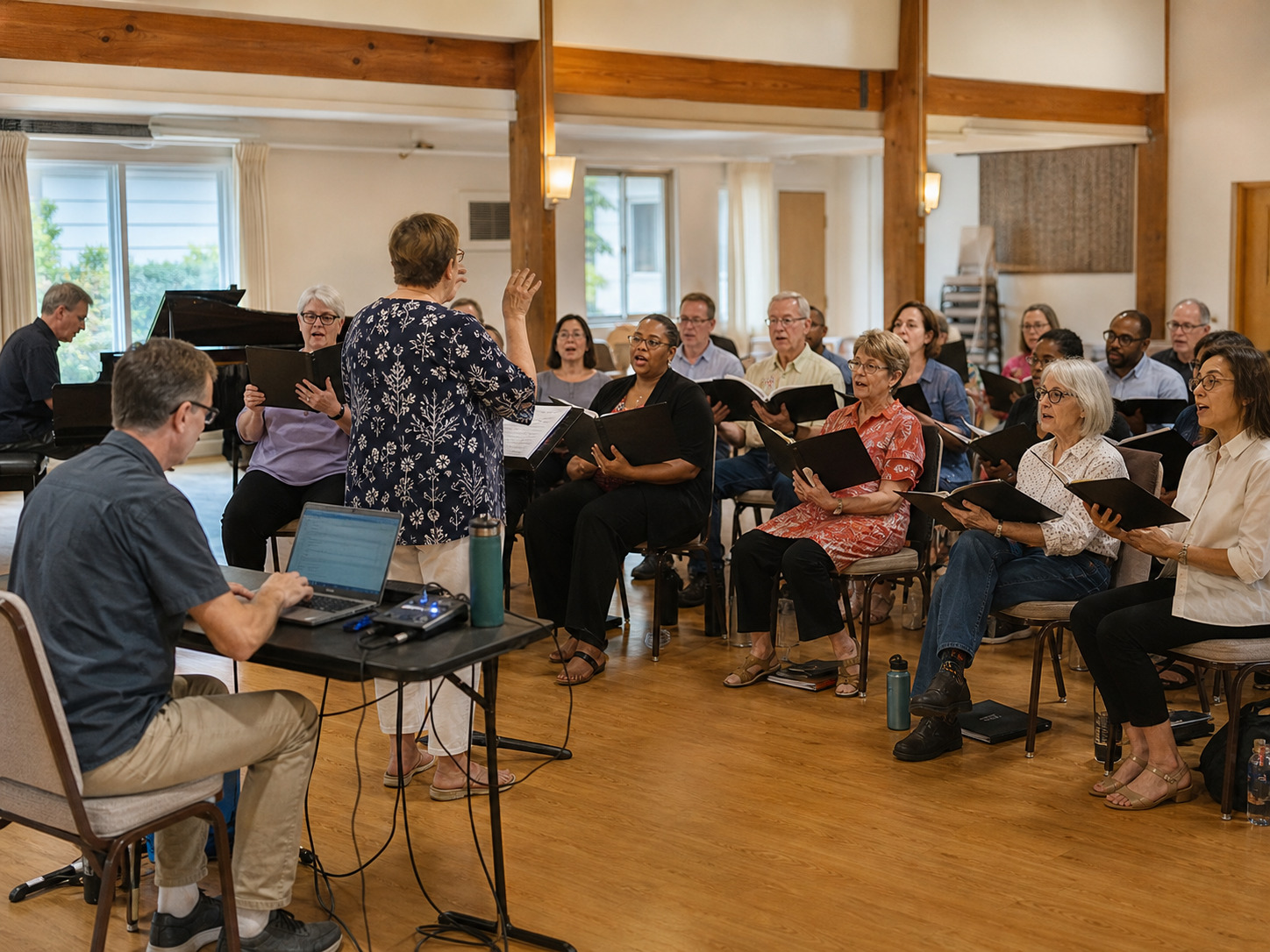
The short answer: a church choir retreat should send every singer home knowing the same musical version, the same rehearsal priorities, and the next step they can practice independently.
A retreat can build community and momentum, but it should not become a long day of sight-reading every anthem on the calendar. Use the time to establish shared sound, solve the most important entrances and transitions, and prepare rehearsal materials people can actually use afterward.
Backing tracks and guide vocals help when they are assigned clear jobs: one teaches, one supports independent singing, and both match the version the choir will perform.
Decide what the retreat must accomplish
Before choosing music, write three to five outcomes for the day.
Useful outcomes might include:
- establish vowel, diction, and blend expectations;
- learn one difficult refrain or anthem section;
- introduce the next worship season without reading the entire folder;
- move singers from guide vocal to accompaniment on one piece;
- test comfortable keys and section balance;
- agree on rehearsal-file names and where materials live;
- build confidence for new or returning singers.
The retreat is successful when the next weekly rehearsal starts farther ahead—not when the choir touched the largest number of songs.
Send the right materials before the day
Give singers enough information to arrive ready without turning the retreat into homework anxiety.
Share:
- the schedule and location;
- the exact pieces the choir will work on;
- guide-vocal demonstrations when available;
- accompaniment tracks for singers ready to practice without the recorded lead;
- sheet music or lead sheets the church is authorized to distribute;
- pronunciation, cut, verse, or key notes;
- what to bring, including water, pencil, folder, and device if used.
Label each file by title, key, and role. A singer should know whether a recording is for learning or for singing independently.
The Spiritrax guide to moving a choir off the guide vocal explains how to make that handoff without removing support too early.
Build the day around energy, not only chronology
A choir does not learn at the same rate all day.
| Retreat block | Best use | Track role |
|---|---|---|
| Arrival | Welcome, breathing, easy familiar singing | Light accompaniment or live warm-up |
| First focused block | New notes, rhythm, diction, sectional work | Guide vocal and section references |
| Midmorning | Put sections together | Accompaniment with clear restarts |
| After break | Hardest entrance or transition | Short loop or marked restart point |
| Afternoon | Worship-season overview and selected repertoire | Brief demonstrations, not every full song |
| Final block | Complete proof run and next steps | Approved accompaniment track |
Put the hardest concentrated work before fatigue changes the room. Use an easy, familiar piece after lunch before asking for another demanding section.
Give the guide vocal one job
A guide vocal is useful for melody, lyrics, phrasing, and entrances. It should not stay on forever.
Try a three-pass sequence:
- Listen and mark: follow the score while hearing the guide vocal.
- Sing with support: sing with the guide and correct notes, words, and releases.
- Own the part: switch to accompaniment and find what the choir can carry independently.
If the choir loses the line during pass three, return to the smallest problem. Rehearse four measures, one entrance, or one transition instead of replaying the entire song from the beginning.
The retreat should teach singers how to use both files after they go home.
Choose keys for the singers who are present
A familiar hymn or worship song can still fail when the key asks the choir to live at the edge of its range.
Listen for:
- sopranos pressing instead of releasing the top;
- altos disappearing below the texture;
- tenors carrying too much of the melody;
- basses losing clarity in the lowest phrases;
- the congregation's likely range when the choir is leading rather than presenting a feature.
Do not transpose during the retreat merely because one pass feels tired. Compare the musical purpose, the whole range, the strongest and weakest sections, and the people who will actually sing in the service.
For a solo-led piece, the church solo key guide provides a practical way to test whether the singer and room can trust the key.
Rehearse entrances and endings before polishing the middle
Choirs often spend most of their time inside the song and too little time entering or leaving it.
At the retreat, practice:
- the spoken introduction into the track;
- the count-in or pickup;
- the first consonant and first pitch;
- a verse-to-chorus transition;
- a cut, repeat, or tag;
- the final release;
- the silence, prayer, or spoken cue after the music.
The service experiences those boundaries as part of the song. A polished middle cannot rescue an uncertain entrance.
Make restart points easy to find
Long recordings waste retreat time when every correction requires a return to the beginning.
Mark shared landmarks such as:
- introduction;
- verse two pickup;
- key change;
- bridge;
- final chorus;
- tag or coda;
- last eight measures.
Write the landmark in the director's notes and say it aloud before restarting. Timestamps can help, but musical language travels better when a new export changes the file length.
If the arrangement needs a different lead-in, key, tempo, cut, repeat, or ending, document the request rather than teaching the choir to work around a repeatable problem.
Protect breaks and non-singing time
A retreat should include real breaks, food, conversation, and a change of physical focus.
Plan short blocks rather than one continuous rehearsal. Invite singers to step away from the sound. Use one non-singing session for worship-calendar context, folder organization, listening, or a brief conversation about the choir's role in congregational participation.
Do not use background music in every break. Quiet helps ears and attention reset.
Include new singers without slowing every section
New singers need a map more than a spotlight.
Pair them with an experienced section member. Explain where files live, how guide and accompaniment versions differ, which markings matter, and how to ask for help. Avoid private accounts or improvised file-sharing paths that only one volunteer understands.
Use one familiar selection early so returning singers can model the rehearsal process. Then teach one new passage with the same steps the choir will use during the year.
The goal is not to hide inexperience. It is to make the rehearsal system legible.
End with a proof run and a small practice assignment
Finish the retreat by running one selection as it will function in worship:
- approved key and arrangement;
- correct accompaniment track;
- real starting cue;
- planned verses, cut, or repeat;
- final release;
- transition into the next service action.
Then give each section one specific next step. “Practice everything” is not a plan.
Examples:
- sopranos: review the bridge entrance with the guide vocal, then sing it twice with accompaniment;
- altos: mark the lower harmony in verse three;
- tenors: practice the pickup after the spoken cue;
- basses: confirm the final release and consonant;
- full choir: run the complete track once before the next rehearsal.
Choir-retreat checklist
Before the day begins, confirm:
- retreat outcomes are written;
- the schedule includes breaks;
- every selected track matches the current key and arrangement;
- guide-vocal and accompaniment files are clearly separated;
- music and files are distributed through an approved shared path;
- playback works offline in the retreat room;
- a speaker, cable, power supply, and backup device are ready;
- restart landmarks are marked;
- new singers have a section contact;
- the final proof run and follow-up assignment are scheduled.
FAQ: church choir retreats and backing tracks
How many songs should a choir retreat cover?
There is no universal number. Choose enough repertoire to establish the season and prove the rehearsal process, but prioritize depth on the pieces with the greatest musical or service risk.
Should singers receive guide vocals before the retreat?
Yes, when available and appropriate. Explain that the guide vocal is a learning reference. Also provide the accompaniment version so singers can practice carrying their own part.
Can backing tracks replace section rehearsals?
They can support section work, but the director still needs to hear balance, diction, tuning, and entrances in the room. Use recordings as a consistent reference, not as a substitute for musical judgment.
Should the choir rehearse every Christmas or Easter piece at the retreat?
Usually not. Introduce the season, then choose representative or high-risk pieces for focused work. Leave enough energy to finish one complete, confident proof run.
The takeaway
A useful choir retreat creates one shared rehearsal language. Choose a few outcomes, separate guide vocals from accompaniment, solve entrances and transitions, test the actual files, and end with a small practice assignment everyone understands.
When singers leave knowing both the music and the process, the next rehearsal can begin with confidence instead of another search for the right recording.
Build the retreat around arrangements your singers can learn and carry with accompaniment sets, guide-vocal demonstrations, and practical rehearsal materials.
Explore Accompaniment Sets