
Let Sukkot Music Make Room for Gathering and Joy
Holiday & Special Occasion Music
By Spiritrax Content Studio · September 8, 2026
Updated September 8, 2026
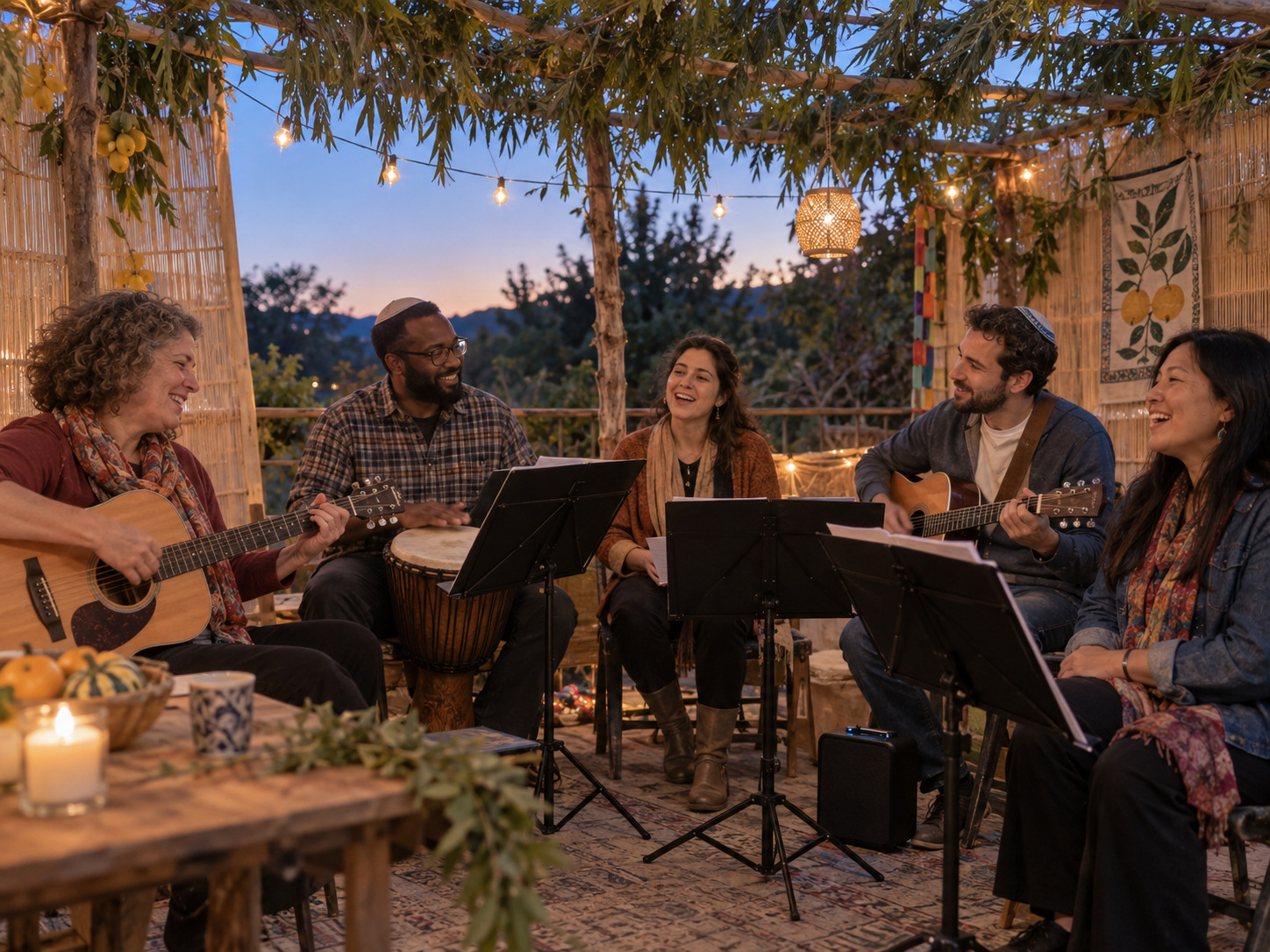
The short answer: a Sukkot music plan should support the way people gather, move, sing, eat, and celebrate together without turning every moment in the sukkah into a performance.
In 2026, Sukkot begins at sundown on September 25 and continues through nightfall on October 2. The holiday comes soon after the solemn High Holy Days and brings a different musical task: making room for joy, hospitality, gratitude, and shared participation.
That does not require a crowded song list. It requires a clear plan for where music helps the gathering and where conversation, ritual, food, and the natural sound of the space should lead.
Start with the kind of Sukkot gathering you are planning
Sukkot music can serve a synagogue program, religious school, family gathering, community meal, youth event, choir presentation, or intergenerational celebration. Those settings do not need the same arrangement or the same amount of music.
Before choosing tracks, answer four questions:
- Who is expected to sing: a cantor, choir, children, families, or the whole gathering?
- Will the music happen in a sanctuary, social hall, outdoor sukkah, classroom, or several spaces?
- Is the moment a service, a meal, a teaching activity, a procession, or informal celebration?
- Which parts must be led, and which parts should be easy enough for people to join without rehearsal?
The answers determine whether you need a focused accompaniment track, a familiar communal song, a short instrumental transition, or no music at all.
Give each musical moment one job
Build the plan around moments, not around the number of songs you can fit.
| Moment | Useful musical job | What to avoid |
|---|---|---|
| Arrival | Welcome people and settle the space | Starting so loudly that greetings become difficult |
| Opening | Give the leader and group one clear beginning | A long introduction no one recognizes |
| Teaching or family activity | Support repetition and participation | An arrangement too dense for new singers |
| Meal or hospitality | Add warmth before returning attention to people | Continuous music that competes with conversation |
| Communal celebration | Carry energy that the group can share | A tempo or key chosen only for the strongest singer |
| Closing | Mark the final shared action and release the gathering | An ending the leader and operator have not rehearsed |
This keeps music connected to the gathering. A song that works beautifully for a cantor-led service may not be the right choice for an outdoor family program. A lively community number may need a shorter introduction and a clearer ending when people are standing close together in a small space.
Plan for the real sound of a sukkah
An outdoor or semi-outdoor sukkah can change what performers and listeners hear.
Street noise, wind, conversations, dishes, children moving, and a lightweight roof can make a quiet introduction difficult to catch. At the same time, a small enclosed gathering can become uncomfortable if the speaker is treated like a sanctuary sound system.
Test the actual space when possible. Listen from the entrance, the center, and the farthest seat. Confirm that people can hear the first musical cue without making the accompaniment dominate the room.
Keep equipment practical:
- Use a charged playback device with notifications disabled.
- Download the final file before the event rather than depending on a live stream.
- Place the speaker where sound can reach people without blocking movement.
- Keep cables away from entrances, chairs, serving areas, and children’s activity paths.
- Protect equipment from weather, moisture, and unstable surfaces.
- Keep a second tested copy of the final file on another device.
If the environment is unsafe for equipment or performers, move the music rather than forcing the original plan.
Choose a key for the people who will actually sing
The most familiar melody can still feel difficult when the key is built around a solo voice instead of a mixed group.
Test the highest and lowest phrases with the intended leader and a small sample of participants. If children, older adults, or an intergenerational group will sing together, listen for the point where people stop participating and begin watching.
A soloist may need space for expression. A communal song needs a center the room can carry.
Spiritrax’s Jewish backing-track category includes several traditional prayers and celebration songs in multiple keys. Preview the actual arrangement and key rather than choosing by title alone. If a needed song or version is not in the catalog, a custom track request can describe the key, tempo, cut, instrumentation, and use case without assuming that every gathering needs the same treatment.
Make the first entrance obvious
Outdoor gatherings often have more visual and conversational activity than a formal rehearsal room. The person leading the music and the person starting the track need one shared cue.
Decide:
- who signals that the group is ready;
- whether the signal is spoken, visual, or counted;
- how long the introduction is;
- which voice or instrument enters first;
- and what happens if people are still moving when the cue arrives.
Do not ask a volunteer operator to guess from across the space. Rehearse the hand signal or spoken line. If the leader needs more time, choose a stable restart point rather than talking over a running introduction.
Let participation grow in layers
Not everyone arrives ready to sing a full arrangement. A layered plan lets people join without being put on display.
Try a progression such as:
- Instrumental music while people arrive.
- One leader or small group introduces the melody.
- The whole gathering joins a repeated section.
- Children or families add a simple rhythmic response when appropriate.
- The accompaniment returns to a clear ending everyone can recognize.
This is especially useful for mixed-experience gatherings. The track supplies a dependable musical frame, while the leader controls how much participation the moment can carry.
Keep Sukkot, Shemini Atzeret, and Simchat Torah distinct
Calendar proximity can tempt planners to treat the entire period as one continuous program. In the Diaspora, Sukkot is followed by Shemini Atzeret and Simchat Torah, which run from the evening of October 2 through October 4 in 2026. Communities also differ in practice, repertoire, and how they structure services and celebrations.
Confirm the calendar and liturgical plan with the clergy, cantor, educator, or community leader responsible for the event. Do not let a generic playlist decide which holiday moment the music is serving.
The production plan can still stay simple: label each file with its exact event, date, version, and cue so a volunteer never has to choose between similarly named exports during the gathering.
Rehearse movement, not only the music
If people will enter, carry objects, gather around tables, move between spaces, or dance, run that movement with the final track.
Check:
- whether the introduction gives the leader enough time to take position;
- whether participants can hear the pulse while facing away from the speaker;
- whether the ending arrives before or after the physical action is complete;
- whether a fade, button, or full ending best supports the next moment;
- and whether the operator can see the person calling the cue.
A track that sounds balanced at a desk may behave differently when the gathering is full. The rehearsal should prove the relationship between the music and the people using the space.
Build a small final playback folder
Keep only approved event files in the active folder. Separate demos, rehearsal guides, and earlier versions.
A useful filename includes:
- order number;
- song or moment;
- key;
- version;
- and event date when several gatherings are close together.
For example, 03_CommunalSong_GMinor_Event_2026-09-27.mp3 is more dependable than song-final-new.mp3.
Give the volunteer operator a short cue sheet with the file, starting signal, expected ending, and next action. Then load the same folder on the backup device.
Sukkot music rehearsal checklist
Use this before the gathering:
- Confirm the event date, holiday context, and community practice.
- Choose each musical moment for one clear purpose.
- Preview the complete arrangement, not only the opening.
- Test the key with the intended singers.
- Download and label the final files.
- Rehearse the first entrance and the final handoff.
- Test volume and speaker placement in the real space.
- Secure power, cables, devices, and weather protection.
- Keep one tested backup device and one person authorized to use it.
- Remove old drafts from the active playback folder.
FAQ: Sukkot music and backing tracks
When is Sukkot in 2026?
Sukkot begins at sundown on Friday, September 25, 2026, and ends at nightfall on Friday, October 2, 2026. Local schedules and observance details should be confirmed with the community hosting the gathering.
Can a backing track work in an outdoor sukkah?
Yes, when the space, weather, power, speaker placement, volume, and cable safety have been tested. Download the file in advance and keep a backup rather than relying on a live connection.
Should the whole gathering sing every selection?
No. Give some moments to a cantor, soloist, choir, children, or instrumental music, and reserve communal singing for music in a comfortable key with a clear entry and repeatable shape.
What if the track is not in the right key?
Test another available key or request a custom version before the event. Rehearse the complete phrase with the intended leader or group; do not judge the key from the highest note alone.
Can I use a general Jewish song for Sukkot?
Repertoire and practice vary. Confirm the selection and its exact role with the clergy, cantor, educator, or community leader responsible for the gathering. The track supports that approved plan; it does not define it.
The takeaway
Sukkot music works best when it helps people gather rather than asking the gathering to serve the music.
Choose fewer, clearer musical jobs. Test the real space. Put the song in a key people can carry. Rehearse the first cue, the movement, and the ending. Then leave room for hospitality, conversation, ritual, and joy to remain audible too.
Preview Spiritrax Jewish backing tracks in available keys, choose music that fits your community’s approved holiday plan, and rehearse the final cue in the space where people will gather.
Browse Jewish Backing Tracks