
Let “O Little Town of Bethlehem” Breathe Without Drifting
Holiday & Special Occasion Music
By Spiritrax Content Studio · October 30, 2026
Updated October 30, 2026
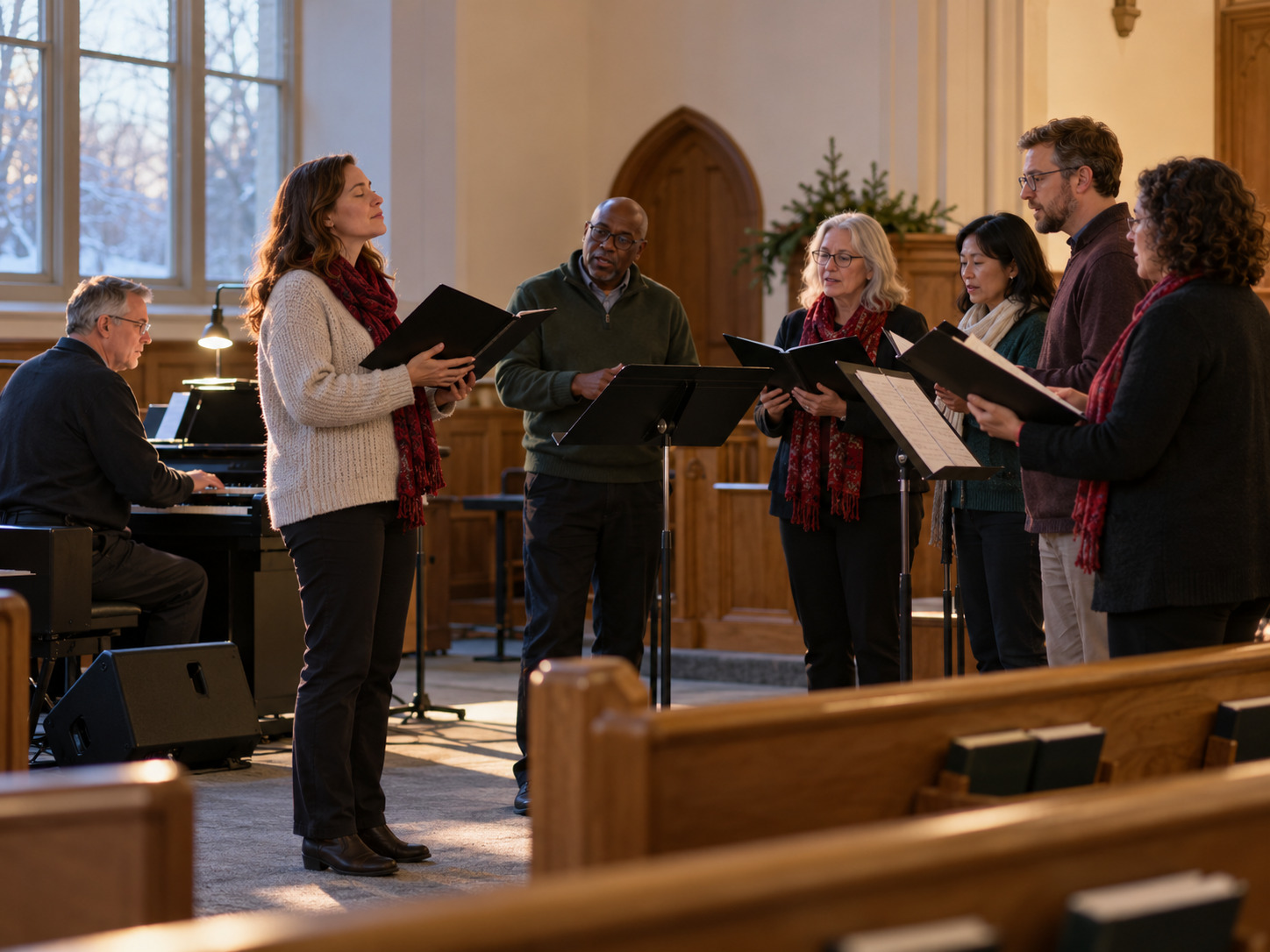
The short answer: choose the exact tune, key, verse order, and leader before rehearsal, then keep a steady pulse underneath an unhurried line. The carol should feel peaceful because the singers agree on the shape—not because the tempo keeps slowing down.
That plan matters with a backing track. A fixed accompaniment provides calm consistency, but it cannot decide in the moment whether a breath will stretch, a verse will be omitted, or the congregation needs a clearer entrance. Those choices belong in the service plan before the first full run.
The Spiritrax “O Little Town of Bethlehem” backing track is available in eleven keys and includes sheet music with lyrics plus a guide demonstration version. That gives a soloist, choir, or worship leader a practical way to compare keys and learn the arrangement before moving to accompaniment-only rehearsal.
Decide what the carol is doing in the service
The same carol can serve very different purposes. It may be:
- a congregational hymn;
- a choir or small-ensemble offering;
- a solo during communion or reflection;
- a response after a reading;
- a quiet transition into prayer;
- or a prelude that prepares the room.
Name the job first. A congregation needs an unmistakable first entrance and a comfortable communal key. A soloist may need more room for color and breath. A choir needs unified consonants and a shared verse arc. Background use needs restraint so the music does not compete with speech.
Once the role is clear, decide who owns the beginning and ending. If no one knows whether the sound operator, conductor, worship leader, or singer gives the cue, a gentle introduction can become an uncertain one.
Confirm the tune and verse order
“O Little Town of Bethlehem” is sung to more than one familiar tune in different traditions. Do not assume that every singer, accompanist, or congregation expects the same melodic shape.
Play the Spiritrax preview before distributing rehearsal notes. Confirm that the chosen recording matches the tune your group intends to sing, then write the exact verse order in the service document. If a printed hymnal, projected slide, or choir folder is involved, check that its words and stanza sequence match the track.
This is especially important when a group has sung the carol for years. Familiarity can hide a version mismatch until the first entrance.
Choose the key for the people in the room
The original Spiritrax arrangement is in D major, with additional available keys from C through E and several choices in between. The best key is not automatically the original key. It is the one that lets the intended singers carry the full verse comfortably and clearly.
Compare keys using the most demanding part of the arrangement, not only the opening line. Ask:
- Can the congregation sing the lowest phrases without losing tone?
- Can the soloist reach the upper phrases without pressing?
- Can the choir sustain the final verse after singing the earlier ones?
- Does the leader remain comfortable enough to cue others?
- Does the key leave room for warmth rather than forcing volume?
Test two likely keys back to back. A small change can make the text easier to understand and the breathing more natural.
Keep the pulse alive inside the stillness
Quiet music often drifts because everyone tries to make it more reverent by slowing down. A better approach is to keep the underlying beat dependable while letting the vocal line travel across it.
During rehearsal, have singers tap or lightly conduct the pulse while speaking the text. Then sing one verse at working volume and listen for places where final consonants or long notes begin to pull the group behind the accompaniment.
Mark three kinds of moments:
- Moving phrases that should travel through the bar.
- Arrival points where the harmony already creates space.
- Breath points that every singer agrees to take without adding an extra beat.
The result can be spacious without becoming fragile. Singers know where the time is, so they do not have to chase the track after every breath.
Build a different purpose for each verse
Repeated music can make singers repeat the same emotional color. Give each verse a job instead.
A simple arc might move through:
- observation;
- quiet wonder;
- inward prayer;
- and a final sense of welcome or hope.
The exact arc should fit the verses your service uses. The point is to avoid treating every stanza as an identical loop.
Change only what supports that purpose. One verse might use a solo voice, another the full choir, and the final verse the congregation. Or the same group may sing throughout while shifting diction, dynamic, and focus. Keep the arrangement manageable for the people and rehearsal time you actually have.
Let the guide demonstration teach the arrangement
Use the guide version to learn entrances, phrase lengths, and the relationship between melody and accompaniment. Then move to the accompaniment-only track early enough that the singers carry the melody and words themselves.
Try this progression:
- Listen once and mark the form.
- Sing one verse with the guide.
- Name the instrumental sound before the first vocal entrance.
- Repeat that verse with accompaniment only.
- Use the guide again only for a specific rhythm or phrase question.
- Finish with the exact accompaniment file planned for the service.
If the group can sing only when the demonstration voice is present, the rehearsal is not finished. The guide is a map, not an additional choir member.
Rehearse the service handoffs
Do not practice only the carol. Practice what happens immediately before and after it.
Start from the real preceding event: a reading, spoken introduction, prayer, silence, or movement into place. Confirm:
- who gives the playback cue;
- how much silence follows the spoken element;
- what the singers hear before entering;
- whether the congregation needs a verbal or visual invitation;
- and whether the microphone is already live.
At the end, decide whether the final chord leads to silence, prayer, movement, or another spoken cue. Protect that transition. An operator who stops the file and immediately changes screens or volume can break the calm the singers just created.
For a larger seasonal sequence, place the carol alongside the Spiritrax Christmas Collection Vol. 1 rather than choosing every song in isolation. Consistent keys, leaders, and playback notes make the full service easier to follow.
A ten-minute sanctuary proof run
Before the final rehearsal ends, test the complete cue in the actual room:
- Stand where the singers will stand.
- Use the final microphone and playback device.
- Begin from the preceding reading or spoken cue.
- Run the first entrance and one complete verse.
- Check whether every singer and the congregation area can hear the introduction.
- Confirm that the accompaniment supports rather than covers the words.
- Run the final verse, last chord, and next service action.
- Save a backup copy under the same clear filename.
This proof run catches practical problems that headphones cannot: speaker delay, a hidden monitor, a microphone that changes the perceived key, or an introduction that disappears once people are in the room.
Rehearsal checklist
Before the carol enters the service order, confirm that:
- the tune matches the congregation's or choir's expected version;
- the exact key and verse order are written down;
- leader, singers, and operator use the same file;
- breaths and consonants stay inside the pulse;
- every verse has a clear purpose;
- the first entrance is audible and confidently cued;
- the group can sing without the guide demonstration;
- the final chord connects cleanly to the next service moment;
- and a backup file is available.
Questions worship teams ask
What is the best key for “O Little Town of Bethlehem”?
There is no single best key for every group. Choose the key that keeps the complete verse comfortable for the actual soloist, choir, or congregation. Compare likely options using the highest and lowest phrases before deciding.
Should the tempo slow at the end of every phrase?
Usually, the arrangement already provides harmonic space. Keep the underlying pulse steady and agree on breaths. Add flexibility only where the whole group and recording can support it.
Can a congregation sing with a backing track?
Yes, when the introduction, key, tempo, and verse order are clear. A visible leader and an audible first pitch make participation much easier.
When should we use the guide demonstration?
Use it while learning the arrangement and diagnosing specific entrances or phrase shapes. Rehearse with accompaniment only before the service so the singers do not depend on the recorded voice.
Can the carol work as a solo instead of a congregational song?
Yes. Choose the key for the soloist, keep the verse order clear, and decide whether the congregation is listening or joining later. A solo can use more vocal color, but it still needs a reliable cue, shared tempo plan, and intentional ending.
The strongest performance will not call attention to the playback system. It will let the room hear a familiar carol with a calm entrance, a shared breath, and a final silence that feels intentional.