
O Come, O Come, Emmanuel Needs More Than a Slow Tempo
Holiday & Special Occasion Music
By Spiritrax Content Studio · September 18, 2026
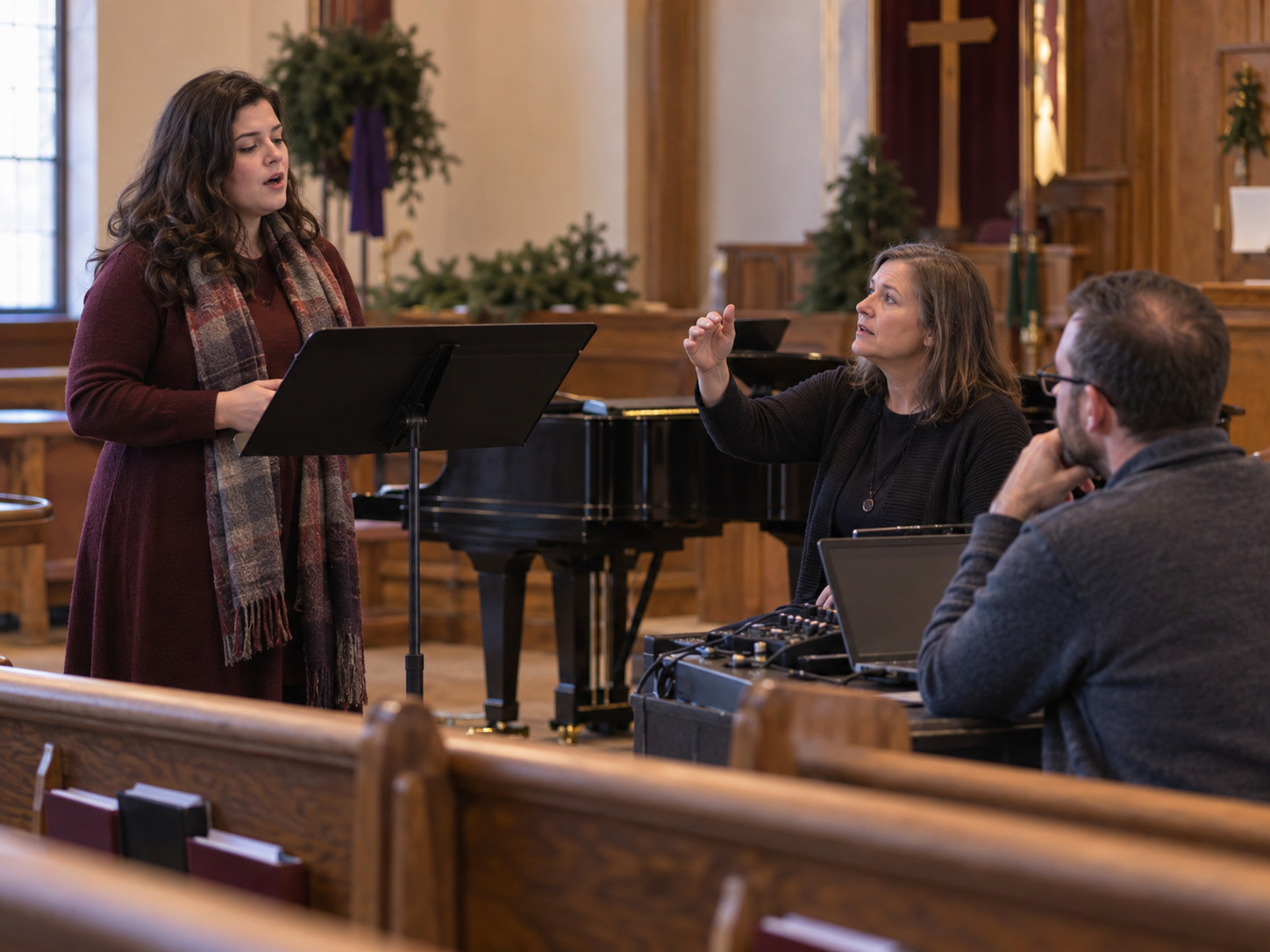
The short answer: rehearse “O Come, O Come, Emmanuel” by mapping the rubato before trying to make it feel spontaneous. Choose the key with the complete melody, learn where the arrangement breathes, assign the first cue, and practice every return to the refrain with the exact accompaniment file intended for the service.
Spiritrax’s arrangement uses solo piano, brass, and percussion in a wide, flexible texture. That spacious sound can support an expressive solo, but it also asks the singer and sound operator to agree on musical landmarks. “Slow” is not a rehearsal plan. A shared phrase map is.
Choose the key by singing past the first verse
The Spiritrax O Come, O Come, Emmanuel backing track is currently available in D minor, E minor, B minor, and G-flat minor. Preview more than one option when needed, then sing enough of the complete form to feel how the refrain and later verses sit after the voice has worked.
Listen for:
- a low opening that remains clear rather than swallowed;
- sustained phrases that do not require a pressed breath;
- a comfortable lift into each refrain;
- words that stay understandable at a quiet dynamic;
- and a final verse that still feels centered.
The familiar melody can make a singer choose from memory instead of evidence. Use the actual arrangement. A key that feels reflective in the first phrase may become too low for clarity or too high for the strongest refrain.
For a congregation, choose a range ordinary voices can enter without strain. For a soloist, protect line, diction, and repeatability. For a choir or small ensemble, check where harmony changes the practical range for each section.
Mark the places where time can breathe
Rubato means expressive flexibility in tempo. It does not mean that every phrase changes length differently on every run.
Listen through the track without singing and mark:
- the length of the introduction;
- the first clear pitch or harmony cue;
- places where the accompaniment broadens;
- points where the singer must continue into the next phrase;
- the approach to “Rejoice”;
- the release at the end of the refrain;
- and the musical cue that begins the next verse.
Use lyric cues and elapsed time if a score marking is not practical. The notes might say:
Introduction settles, singer breathes after the final brass cue, verse stays forward through the middle line, refrain broadens only where the accompaniment opens, and the last word releases with the track.
That description gives rehearsal a repeatable shape without flattening the song into strict mechanical time.
Let the accompaniment tell you what cannot wait
A backing track will not pause because the singer took an extra breath. Find the places where the arrangement offers space and the places where the next harmony arrives on schedule.
Practice in short sections:
- Speak the text over the accompaniment and circle any word that lands late.
- Hum the melody while matching the track’s arrivals.
- Add the words at a comfortable dynamic.
- Sing the phrase before and after each breath so the connection remains clear.
- Run the complete verse and refrain without stopping.
When a singer falls behind, do not assume the whole track is too fast. The issue may be one late consonant, an oversized breath, a held note that continues past the accompaniment, or uncertainty about the next pickup.
The worship backing-track setup guide offers a wider plan for cueing, speaker balance, downloaded files, and service-ready playback.
Rehearse every return to “Rejoice”
The refrain is the musical and emotional center of the hymn. Its familiarity can hide inconsistent entrances.
For each verse, isolate the last line and continue through the complete refrain. Confirm:
- where the singer begins the first word;
- how much the phrase broadens without losing the track;
- whether the strongest note remains musical rather than pushed;
- where the final word releases;
- and whether the next verse begins from a clear cue.
If a choir or congregation joins on the refrain, rehearse the invitation. Decide whether the service leader speaks beforehand, gestures during the final line of the verse, or lets a printed order establish the pattern. One leader should make the entrance obvious without talking over the musical introduction.
Avoid changing the invitation from verse to verse. The room should not have to guess whether the refrain is solo, choir, or congregational each time it returns.
Give each verse a service job
The current product page presents five stanzas. A service may use the complete form or an intentionally selected set, depending on the worship plan and applicable permissions. Make that decision before rehearsal.
For every included verse, name:
- who sings;
- whether the congregation joins;
- what visual or spoken element happens around it;
- whether the same dynamic and instrumentation continue;
- and how the verse leads into the next refrain.
Do not let an omitted verse become a surprise cut during playback. Use the exact track structure the singers and operator have rehearsed. If the service needs a different form, confirm that the intended audio and permissions support it before preparing a replacement.
Spiritrax’s Christmas backing-track catalog can help planners compare other Advent and Christmas selections when building a complete service arc.
Keep the visual moment quieter than the music
This hymn often accompanies an Advent opening, a processional, a reading, or a contemplative transition. Those elements can work well when they do not compete for the same attention.
If people will move during the track:
- time the movement in the real room;
- decide whether it begins before the first verse or during a settled instrumental space;
- give the operator one exact start cue;
- keep spoken instructions outside the most exposed vocal phrases;
- and finish movement before asking the congregation to watch for another cue.
Do not treat rubato as extra staging time. Musical space still has a shape and an ending. If the movement consistently takes longer than the arrangement provides, change the service order or use a separately approved music plan rather than asking the singer to wait for a track that has already moved on.
Balance the track so the text can lead
Solo piano, brass, and percussion can sound intimate in one room and unexpectedly broad through another sound system. Test the purchased accompaniment file with the actual singer or group.
Listen from several places:
- near the front, where brass or low frequencies may feel larger;
- the center, where voice and accompaniment should connect;
- the rear, where quiet consonants may disappear;
- and the singer’s position, where the accompaniment must be audible without forcing volume.
Lower the track before asking the singer to compete with it. The words carry the service meaning. A beautiful instrumental color should support them, not cover them.
If the service is streamed, recorded, or reposted, confirm the applicable permissions separately. A successful room rehearsal does not answer every media-use or distribution question.
Use the guide vocal as a learning reference
The product page notes a guide vocal by Cassie Davis. Use the demonstration to learn the melody, phrasing, and entrances when helpful, then rehearse the service with the exact accompaniment-only download.
Keep the filenames plain:
O Come Emmanuel - KEY - guide vocal - rehearsalO Come Emmanuel - KEY - accompaniment - service
Online previews contain an audio watermark voiceover, while downloaded accompaniment tracks do not. Use the preview to compare arrangements and keys, but do not build the final service plan around the watermarked preview.
The operator should see only the intended service file in the active playlist. Turn off crossfade, autoplay, notifications, and sleep behavior that could interrupt the opening silence or begin another file after the final release.
Rehearse the ending and what follows
The final refrain needs a destination.
Decide whether the service will continue with silence, prayer, a reading, another hymn, or a spoken welcome. Then run the complete transition:
- Sing the final refrain at the intended dynamic.
- Release the last word with the accompaniment.
- Let the final sound finish naturally.
- Hold the agreed silence.
- Begin the next service element from one visible or spoken cue.
Do not let the operator fade early because the room became quiet. Do not let a speaker begin while the accompaniment is still completing its cadence. The ending can feel spacious and dependable at the same time.
O Come, O Come, Emmanuel rehearsal checklist
- Preview the available keys and sing beyond the first verse before choosing.
- Mark the introduction, breaths, broadening points, refrain returns, and ending.
- Distinguish expressive rubato from a phrase that simply arrives late.
- Practice every verse-to-refrain connection.
- Decide who sings each verse and refrain.
- Rehearse any congregational invitation or visual movement.
- Use the downloaded accompaniment file for the final sound check.
- Keep the guide vocal and watermarked preview out of the active service playlist.
- Test voice and accompaniment balance in the actual room.
- Plan the silence or spoken event after the last note.
Common questions about an O Come, O Come, Emmanuel backing track
Can a backing track still support rubato?
Yes, when the singer learns where the arrangement already allows space and where the accompaniment moves forward. Map those landmarks and rehearse the same musical shape instead of changing every phrase unpredictably.
Which key should a soloist choose?
Choose the key that supports the complete melody, repeated refrains, diction, and final verse. Preview the available D minor, E minor, B minor, and G-flat minor versions, then test the likely choice with the singer.
Should the congregation sing every refrain?
That depends on the service plan. If the congregation will join, make the first invitation clear and keep the pattern consistent so people know when to enter.
Can we rehearse with the online preview?
Use the preview to compare the arrangement and keys. Rehearse the final service with the purchased download because the online preview includes a watermark voiceover.
Should the track begin under a reading or prayer?
Only after the overlap has been rehearsed in the room and the spoken words remain clear. A clean handoff after the reading is often easier for the singer, operator, and congregation to follow.
The takeaway
Rubato sounds free when the preparation underneath it is clear.
Choose the key with the full voice in mind, mark where the accompaniment breathes, rehearse every return to the refrain, and give the first cue and final silence an owner. Then the track can support an Advent moment that feels spacious, reverent, and secure.
Preview the Spiritrax O Come, O Come, Emmanuel arrangement in the available minor keys, then choose the accompaniment version that supports your singer and Advent service plan.
Preview the Available Keys