
Let the Readings Shape the Music in a Lessons and Carols Service
Holiday & Special Occasion Music
By Spiritrax Content Studio · August 21, 2026
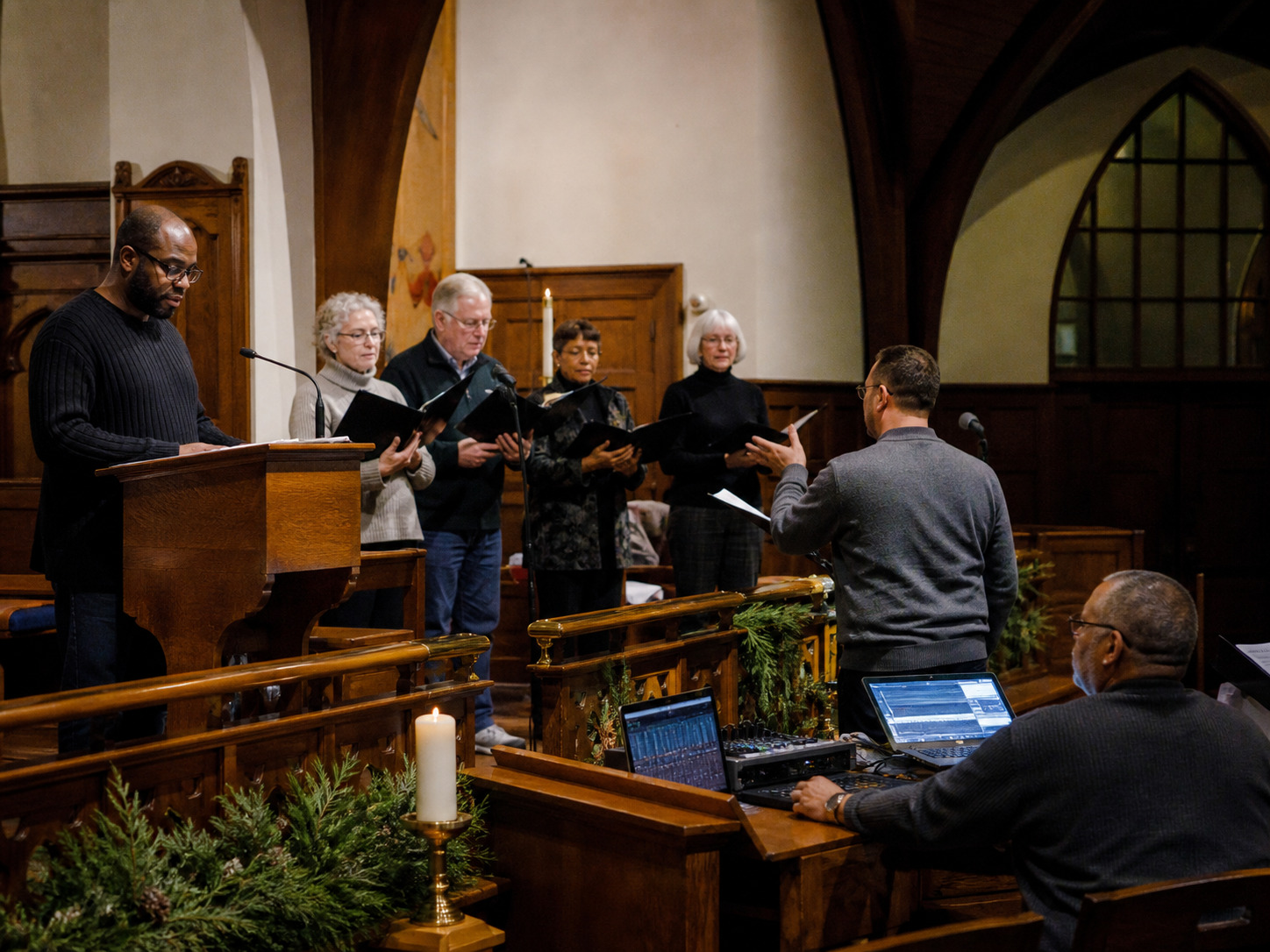
The short answer: a Lessons and Carols service works best when each reading gives the next piece of music a clear purpose.
The music is not a stack of Christmas favorites placed between Scripture passages. It carries the room from promise to incarnation, from listening to singing, and from quiet reflection to shared praise.
Backing tracks can support that shape when the choir is small, the accompaniment team is limited, or several soloists and readers must coordinate in one service. The practical work is to choose singable keys, protect the silence around the readings, and give every musical entrance one clear owner.
What is a Lessons and Carols service?
A Lessons and Carols service tells the story of God’s saving work through a sequence of Scripture readings, prayers, carols, hymns, and choral or solo music.
The best-known Nine Lessons and Carols tradition is associated with King’s College, Cambridge. King’s records that its festival began on Christmas Eve in 1918 and, since a 1919 revision, has opened with “Once in Royal David’s City.” The exact musical selections have continued to change, showing that the service is a living pattern rather than one fixed concert program.
The United States Conference of Catholic Bishops describes its Festival of Lessons and Carols as a service in which each lesson is followed by music that reflects the reading and a brief prayer. Churches, schools, chapels, choirs, and community groups may use different numbers of readings or follow their own approved worship tradition.
The planning principle remains useful across those settings: let the story determine the musical job.
Begin with the readings, not the song list
Read the complete service aloud before choosing arrangements.
For each lesson, ask:
- What changes in the story here?
- Does the room need to listen, respond, pray, or sing?
- Should the next music be congregational, choral, solo, instrumental, or silent?
- Does this moment call for restraint or a fuller sound?
- Will the music introduce the next reading, reflect on the one just heard, or carry the assembly between them?
This prevents a common planning problem: every individual song is strong, but the complete service has no emotional or narrative movement.
Use the official King’s College history of the Festival of Nine Lessons and Carols and the USCCB Festival of Lessons and Carols as useful background. Follow your church, denomination, school, or organization’s approved texts and worship guidance for the service you are actually preparing.
Give each musical selection one job
A simple planning table keeps the service from becoming crowded.
| Service moment | Musical job | Arrangement question |
|---|---|---|
| Gathering | Settle the room and invite attention | Can people enter without being asked to listen immediately? |
| Opening hymn | Establish shared participation | Is the key comfortable for the congregation? |
| Early lesson | Reflect promise, longing, or creation | Would a quieter solo or instrumental response leave more room? |
| Prophetic lesson | Build expectation without resolving too soon | Does the arrangement stay inside Advent’s waiting when needed? |
| Annunciation or Nativity lesson | Bring the story closer and more personal | Should the sound become warmer, simpler, or more intimate? |
| Shepherds or Magi | Add movement and discovery | Can rhythm lift without turning the reading sequence into a show? |
| Final Gospel or sending | Gather the whole story in praise | Is this the right place for the fullest congregational sound? |
Not every lesson needs a complete song. A verse, refrain, short instrumental response, choral piece, silence, or prayer may serve the story better.
Protect the difference between Advent and Christmas
Some Lessons and Carols services happen during Advent. Others happen on Christmas Eve or in Christmastide. That timing affects the musical arc.
An Advent service may spend more time in longing, prophecy, and expectation before reaching explicit Nativity music. A Christmas service may move more quickly into familiar carols of the birth of Jesus.
Do not let one enthusiastic opening selection resolve the whole story before the readings have begun. Keep enough contrast that the room can feel the movement from waiting to arrival.
The Spiritrax Christmas backing-track library can help a planning team compare arrangements and keys. Choose the version that fits the place of the song in the service, not simply the largest arrangement available.
Choose keys for the people who will actually sing
A familiar carol can become difficult when the congregation receives a high original key, a short introduction, or a final verse that climbs after a long service.
Before confirming a track:
- identify whether the selection is led by a soloist, choir, children, or the full congregation;
- test the highest and lowest phrases with the intended singers;
- decide whether the congregation joins every verse or only a refrain;
- confirm that the opening pitch is easy to hear;
- and rehearse the final verse after the complete arrangement, not only from a fresh start.
A comfortable congregational key may differ from the best solo key. If one selection changes leaders, decide whose singing the arrangement must primarily support.
Guide-vocal demonstrations can help a volunteer singer or choir learn the melody and entrance. Move to the matching accompaniment-only track early enough that the singers can carry the line without leaning on the reference voice.
Build the reader-to-music handoff
The most fragile part of the service is often the space after a reading.
Decide the complete handoff:
- The reader finishes the final sentence.
- The room receives a planned breath or silence.
- One person gives the musical cue.
- Playback begins with a known introduction.
- The soloist, choir, or congregation enters from a clear landmark.
Avoid an automatic start the moment the reader finishes. The reading needs time to land. The length of that silence may vary by room and tradition, but the responsibility should not be ambiguous.
Document who owns each start. That may be the worship leader, director, organist, conductor, or sound operator acting on a visible or called cue. The person running playback should not have to interpret whether the reader’s movement, a page turn, or a long pause means “go.”
Use backing tracks without flattening the service
Consistent playback is valuable, but a service built from tracks can feel musically uniform if every selection has the same scale and intensity.
Create contrast through choices the room can actually perform:
- congregational hymn followed by silence;
- solo or small ensemble after a reflective lesson;
- a lighter instrumental texture beneath gathering or movement;
- unaccompanied opening or closing phrases when the singers are prepared;
- full choir or congregation at the story’s clearest point of arrival;
- and spoken prayer without background music.
Do not add music beneath every reading. Speech clarity and attention matter more than continuous sound.
When using an instrumental track under movement or prayer, confirm that the arrangement has a stable section, appropriate length, and an ending that will not force the leader to rush. If the service needs a fade, rehearse the actual fade point and level.
Plan the service as one playback sequence
Create one show-order document for the worship leader, reader coordinator, music director, and sound operator.
For each musical item, list:
- service position;
- lesson or prayer it follows;
- title and exact filename;
- accompaniment or guide-vocal status;
- key;
- leader and participating group;
- start cue;
- length of silence before the cue;
- first audible landmark;
- verse or refrain plan;
- ending or fade;
- and the next reader, prayer, or movement.
Keep old keys and rehearsal versions outside the live folder. Download the final files before the service and keep a backup copy on a second tested device.
The same principle applies to a candlelight conclusion. The Spiritrax guide to a Christmas Eve candlelight service can help when readers, light movement, silence, and a final congregational carol must share one calm sequence.
Rehearse transitions before complete songs
If rehearsal time is limited, test the edges first.
For every lesson-and-carol pairing:
- Read the final paragraph of the lesson.
- Hold the planned silence.
- Give the real playback cue.
- Sing the first phrase.
- Jump to the final verse or ending.
- Continue into the next prayer, movement, or reader entrance.
This short pass reveals whether the silence feels intentional, the introduction is clear, the key is singable, the ending releases the room, and the next person knows when to move.
Then rehearse complete selections that carry special musical risk: exposed solos, children’s entrances, unaccompanied passages, descants, final-verse key changes, unfamiliar arrangements, and music under movement.
Keep the sound supportive and speech clear
Test the service through the actual room system.
Check:
- accompaniment level against a single reader and a full congregation;
- whether the first notes are audible from the back and sides of the room;
- monitor coverage for soloists and choir;
- microphone handoffs between readers;
- the level of any track used beneath movement or prayer;
- and whether the final chord leaves enough space before the next words.
A track should support the room, not announce every transition. Lowering a fader may be the right solution when the arrangement is suitable but the balance is not.
A practical 75-minute rehearsal plan
First 10 minutes: story and ownership
Review the reading sequence, approved text source, musical jobs, readers, music leaders, playback operator, and the person who releases each cue.
Next 20 minutes: lesson-to-music openings
Run the final paragraph, silence, cue, introduction, and first phrase for every pairing. Fix unclear ownership before rehearsing full songs.
Next 15 minutes: keys and participation
Test exposed congregational ranges, solo entrances, children’s parts, choir pickups, and any verse where participation changes.
Next 15 minutes: endings and movement
Run final verses, fades, reader approaches, microphone handoffs, processions, candles, and the first spoken words after each selection.
Final 15 minutes: continuous story pass
Run the largest practical sequence without coaching. Mark where the service lost clarity, where music crowded the reading, and where a cue needed one simpler instruction.
Lessons and Carols music checklist
Before the service, confirm that:
- the reading sequence follows the organization’s approved worship plan;
- every musical selection reflects a specific lesson or service job;
- Advent and Christmas material follow a deliberate arc;
- keys fit the soloists, choir, children, and congregation who will sing;
- readers and music leaders share the same show order;
- every lesson-to-music handoff has one cue owner;
- silence is planned rather than accidental;
- guide-vocal and accompaniment files are clearly separated;
- final files are downloaded and available offline;
- the actual sound system, microphones, and monitors have been tested;
- primary and backup devices hold the same approved sequence;
- and the service has enough musical contrast to keep the story clear.
FAQ: Lessons and Carols with backing tracks
Does every service need nine lessons?
No. Nine Lessons and Carols is a specific, influential tradition. Other churches and organizations use shorter or adapted sequences. Follow the approved worship pattern, texts, and guidance for your setting.
Should every lesson have a full carol?
Not necessarily. A refrain, verse, solo, choral response, instrumental selection, prayer, or silence may serve the reading more clearly than another complete congregational song.
Can a small choir use backing tracks?
Yes. Choose arrangements and keys the choir can carry, use guide vocals during learning when helpful, and move to the accompaniment-only files before the service. Test monitor coverage and entrances in the actual room.
Who should start the track after a reading?
Assign one cue owner. The operator should receive a visible, called, or clearly documented release rather than guessing from the reader’s movement or the length of the pause.
The useful test
At the final rehearsal, ask: Does every piece of music help the congregation hear the story more clearly?
If the answer is yes, the service has a strong center. The readings are not interruptions between songs, and the songs are not decorations between readings. Together, they carry one story the room can listen to, sing, and remember.
Build a practical Christmas service plan with accompaniment tracks, sheet music, and guide-vocal demonstrations for rehearsal.
Explore Christmas Music Vol. 1