
Communion Music Should Leave Room for the Table
Worship Music & Hymn Resources
By Spiritrax Content Studio · July 16, 2026
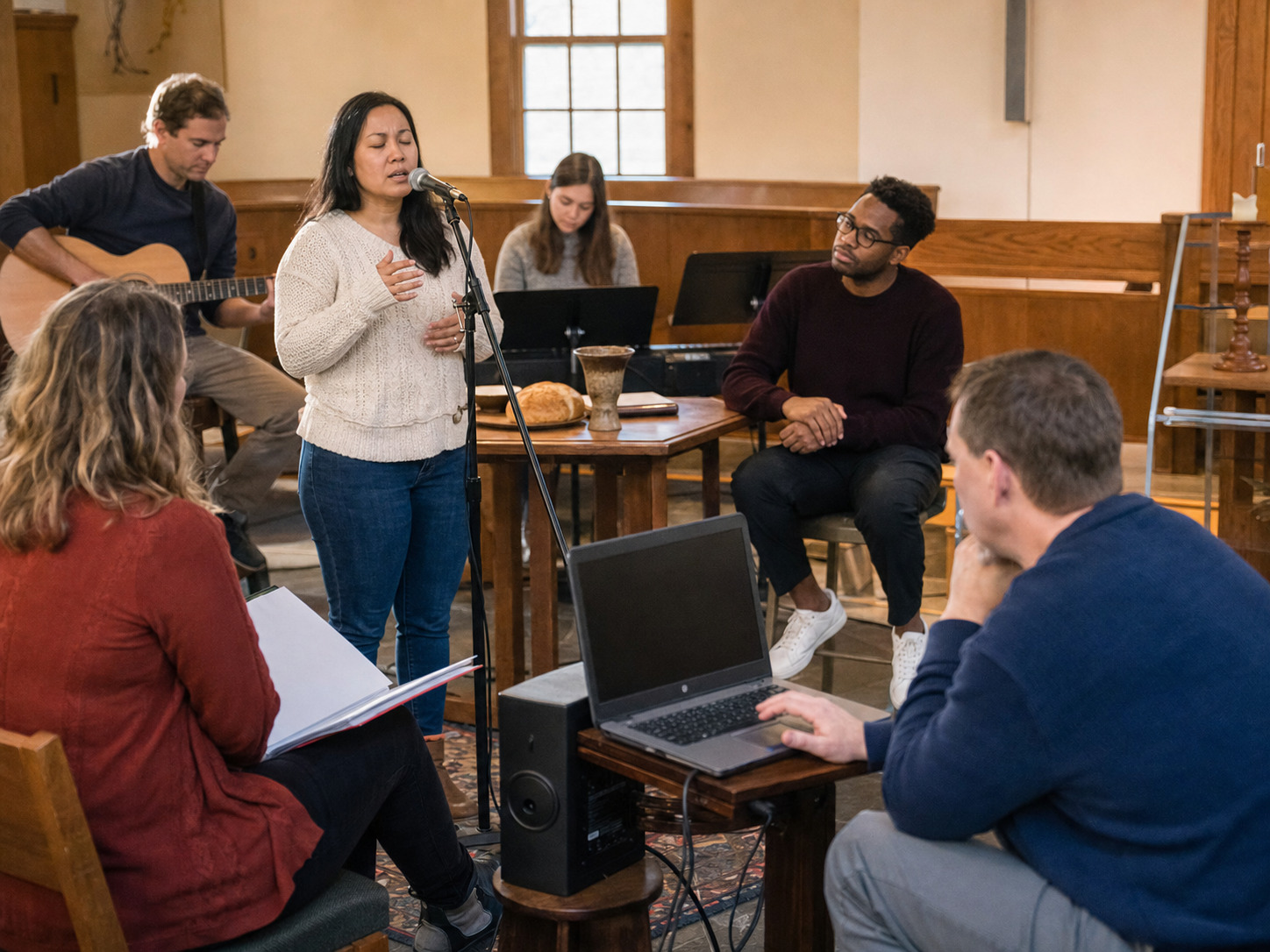
The best communion music does not ask the room to watch it. It helps the room stay present.
A backing track can support a soloist, choir, small worship team, or congregation when a pianist is unavailable or when the service needs a consistent arrangement. The plan works best when the music fits the movement of communion: a clear beginning, a comfortable key, enough length for the room, restrained volume, and an ending that does not hurry the moment.
Decide what the music is doing
Communion practices differ across churches and traditions. Begin with the service plan already approved by your pastor, priest, worship leader, or planning team.
The music may need to:
- introduce communion;
- support prayer or reflection;
- accompany people as they move through the room;
- give a soloist or choir a focused offering;
- help the congregation sing together;
- cover a transition without making it feel like filler;
- end in silence before the next spoken element.
Those are different jobs. A featured solo can carry more musical detail. Music under movement often needs steadier dynamics and a less demanding focal point. Congregational singing needs a familiar melody, clear pulse, and singable key.
Choose solo, choir, congregation, or instrumental use
Name who is expected to sing before choosing the track.
| Use | What the track should provide | What to avoid |
|---|---|---|
| Soloist | Comfortable key, clear entrance, supportive arrangement | A key chosen only because it matches the original recording |
| Small choir | Predictable form, audible introduction, space for blended voices | Dense accompaniment that covers the ensemble |
| Congregation | Familiar melody, communal range, steady tempo | Long or unfamiliar introductions |
| Instrumental reflection | Even dynamic shape and a calm ending | A dramatic build that competes with prayer or movement |
One service may use more than one role. Keep the handoff clear. If a solo begins and the congregation joins later, mark exactly where that invitation occurs.
Spiritrax’s classic hymn backing tracks provide a practical place to look for familiar accompaniment that can serve soloists, choirs, and worship teams.
Match the music to the time the room needs
Do not guess how long communion will take from the track length alone.
Estimate:
- how many people are participating;
- whether people remain seated or move;
- how many serving stations are used;
- whether instructions or prayers happen during the music;
- whether the service needs one song, a repeat, or a second selection;
- what the operator should do if the movement ends early or runs long.
The safest plan is not always to find one very long track. A short sequence of familiar pieces can be easier to manage than a single arrangement that builds beyond the tone of the room.
If the song finishes before the service moment does, know the approved response. The operator may repeat an instrumental section, move to a second track, lower into silence, or wait for a cue. Do not create an unplanned loop during the service.
Pick the key for the live singer
Communion often asks for a quieter vocal approach than a featured concert moment. A key that feels exciting at full voice may feel exposed when the singer is leading gently.
Test:
- the first entrance;
- the highest phrase;
- the lowest reflective verse;
- the final sustained note;
- the place where the congregation or choir joins.
Choose the key that supports a calm, confident delivery. If a soloist is leading, rehearse with the actual microphone and room volume. If the congregation joins, make sure the range works for mixed voices rather than only the leader.
For more detail, use the Spiritrax guide to choosing a church-solo backing-track key.
Keep the arrangement below the moment
The accompaniment should be audible without becoming the emotional center of the room.
During rehearsal:
- set the track below the live voice;
- walk to the back of the room and listen;
- confirm spoken prayer remains clear;
- watch for orchestral builds that become too prominent;
- check whether percussion changes the tone of a quiet section;
- lower the track before the ending if the next element begins softly.
Do not judge volume from laptop speakers. Test through the sanctuary system or the same compact speaker the service will use.
Give the operator a cue plan
The sound operator should not have to interpret the service from a filename.
Provide a short cue sheet with:
- exact file name;
- spoken or visual start cue;
- whether the track begins under speech or after silence;
- the singer’s first entrance;
- any repeat, skip, or second-track instruction;
- the expected end cue;
- fade guidance if an early finish is allowed;
- the next spoken or musical element.
A simple cue might read:
Start after the invitation to communion. Soloist enters after the four-bar introduction. If distribution continues after the final verse, move to Track 02 on the worship leader’s nod. End cleanly and hold silence for prayer.
Use the exact cue language the team will use in the room. Rehearse the transition, not only the song.
Prepare a plan that can become quieter
Communion can move faster or slower than expected. Build a plan that can reduce gracefully.
| If the service runs… | Use this response |
|---|---|
| Shorter than expected | Finish the current phrase or use the approved fade |
| As planned | Let the song reach its intended ending |
| Longer than expected | Move to the prepared second track or approved repeat |
| More quietly than expected | Lower accompaniment and leave more space between elements |
Silence is a valid part of the plan. The operator does not need to fill every second.
Rehearse the whole transition
At least once before the service, run:
- The spoken cue before the music.
- The track introduction.
- The singer or choir entrance.
- The point where communion movement begins.
- The possible switch to a second track.
- The ending, silence, and next spoken element.
This rehearsal helps the worship leader, singer, server, and operator understand the same flow. It also reveals whether the introduction is too long, the volume is too strong, or the ending arrives before the room is ready.
If your church is building a broader worship plan without a regular accompanist, the Spiritrax article No Pianist This Sunday? includes a practical playback and backup checklist.
Communion music checklist
- Confirm the approved service order and communion practice.
- Decide whether the music is solo, choir, congregational, or instrumental.
- Choose a comfortable live key.
- Estimate the time the room needs.
- Prepare a second track or approved quiet ending.
- Download files for offline playback.
- Put tracks in service order with clear names.
- Test the real microphone, device, and speaker system.
- Give the operator start, transition, and end cues.
- Rehearse the silence after the music.
- Keep a backup copy on a second device.
FAQ: communion music with backing tracks
How many songs are needed during communion?
There is no universal number. Use the service’s approved practice, room size, and expected participation time. One well-planned song plus silence may serve better than a crowded set.
Should communion music be instrumental?
It can be instrumental, but it may also be led by a soloist, choir, worship team, or congregation. Choose the form that supports the service rather than distracting from it.
Can the operator repeat a backing track if communion runs long?
Only if the planning team has approved the repeat and the musical transition is understood. Prepare the loop, second track, or fade before the service instead of improvising it live.
What makes a good communion backing track?
A good choice has a comfortable key, clear entrance, predictable structure, restrained dynamics, practical length, and an ending that leaves room for prayer or the next service element.
The takeaway
Communion music works when it supports the table, the people, and the service flow. Decide the music’s role, choose the key for the live singer, match the track plan to the time the room needs, rehearse operator cues, and let the ending make space for silence. The accompaniment should help the moment feel prepared without asking to become the moment.
Choose familiar hymn accompaniment for solo, choir, or congregational use, then match the key, length, and arrangement to the way communion moves in your service.
Explore the Classic Hymns Collection