
Let “Come, You Thankful People, Come” Gather the Room Before It Grows
Holiday & Special Occasion Music
By Spiritrax Content Studio · November 3, 2026
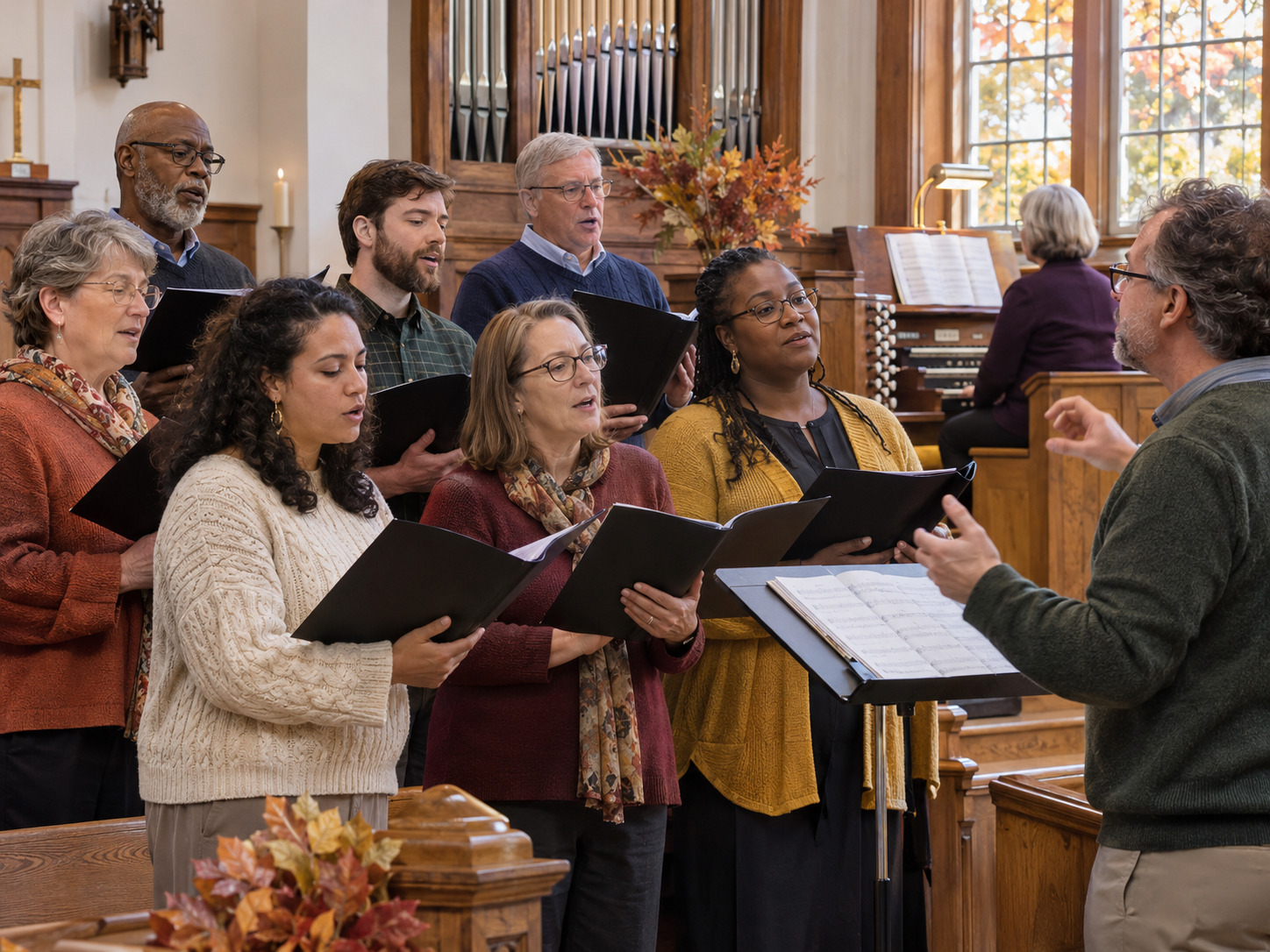
The short answer: establish one warm, processional pulse, choose the key for the people who will actually sing, and let each stanza grow from gratitude toward responsibility and hope. “Come, You Thankful People, Come” works best when the organ accompaniment gathers the room instead of pushing it.
The Spiritrax “Come, You Thankful People, Come” backing track is a traditional solo-organ accompaniment offered in F major, E-flat major, and B-flat major, with sheet music included. Those choices make it useful for a soloist, choir, or congregation, but the service team still needs to select one version and rehearse how the room will enter, breathe, and finish together.
Choose the service role before the key
Decide what the hymn is doing in this particular gathering.
It might serve as:
- an opening procession or call to worship;
- a choir anthem that invites reflection;
- a congregational Thanksgiving hymn;
- music around an offering or stewardship moment;
- or a sending piece that connects gratitude with action.
One arrangement can support several roles, but it should not try to do all of them at once. Name the leader, the expected participants, and the event immediately before and after the track.
Use a small planning table:
| Service role | Who leads | Track question |
|---|---|---|
| Gathering | choir or congregation | Is the introduction clear enough for a confident first entrance? |
| Choir feature | conductor and choir | Can every section hear the organ pulse and verse changes? |
| Solo or small group | one singer or ensemble | Does the selected key support the complete range? |
| Offering or stewardship | soloist, choir, or room | Will movement distract from the text or entrance? |
| Sending | congregation or choir | Does the final release hand cleanly to the next spoken or visual cue? |
This prevents a familiar hymn from being added to the service without a practical plan.
Test all three keys with the complete melody
The available keys are F major, E-flat major, and B-flat major. Do not choose from the first phrase alone.
Have the intended leader or group test:
- the lowest complete phrase;
- the highest sustained note;
- the final stanza after the voice has already been working;
- the first pitch after any spoken introduction or procession;
- and the ability to keep words clear at the planned dynamic.
For a solo feature, center the soloist's healthy range. For a choir, listen for balance across sections rather than the comfort of only the strongest singers. For a congregation, favor a key that mixed voices can carry without the leader having to overpower the room.
Once the key is chosen, put only that file in the service folder. Alternate keys can remain in a separate planning location so the playback operator cannot select the wrong version on Sunday.
Give the organ pulse room to breathe
A traditional organ accompaniment can feel spacious without becoming slow. The team needs a shared sense of forward motion.
Rehearse the introduction and first entrance several times before singing full stanzas. Ask everyone to feel the larger phrase instead of counting every beat heavily. Then mark where the text needs a collective breath and where consonants must release together.
If the singers drag, check three things before asking for more volume:
- Can they hear the accompaniment clearly?
- Is the chosen key making the lower phrases feel heavy?
- Are breaths and final consonants happening at different times?
Fix the earliest cause. A louder track may cover the choir without restoring the pulse.
Shape the stanzas instead of repeating one volume
Familiar hymn form can tempt a group to sing every stanza with the same weight. Give each stanza one service-facing purpose.
The first may welcome the room. The next can deepen attention to gratitude and stewardship. A later stanza may broaden the perspective beyond the immediate celebration. The final stanza should complete the arc rather than simply become louder.
Write one action word beside each stanza, such as gather, notice, offer, or send. The exact choices should fit the service plan and the text approved by the worship leader. Then use dynamics, diction, and vocal color to make the progression audible.
For a choir, decide where unison creates clarity and where harmony adds meaning. For a congregation, keep the leader's gestures and the track level consistent enough that people can enter without guessing.
Plan the handoff into the hymn
Thanksgiving services often connect music with readings, prayers, offerings, children's participation, or movement. The transition deserves rehearsal.
Confirm:
- the exact spoken or visual event that triggers playback;
- who gives the operator the cue;
- whether people are seated, standing, or moving during the introduction;
- when the first pitch becomes audible;
- whether the congregation receives a clear invitation to sing;
- and what happens after the final organ release.
Run the handoff from the actual preceding event. A perfect musical entrance can still feel awkward if the room is unsure whether to stand or if an offering procession blocks the choir's first cue.
If movement is involved, keep the path simple and test it with the complete introduction. Do not assume a procession or microphone handoff will fit because it worked without playback.
Balance the track below the words
The organ should give the singers pitch, harmony, and motion without making the text distant.
During sound check, listen from the center and sides of the room. Test the quietest phrase, the fullest organ passage, and the final stanza. Confirm that:
- singers can hear the introduction and first pitch;
- the congregation can hear its own sound;
- the choir does not push to compete with speakers;
- the leader remains audible without sounding detached from the room;
- and the final release is clear to the sound operator and worship leader.
Record a short run from audience distance. If words disappear, reduce or reshape the playback balance before asking the singers to work harder.
Move from learning to service playback
Use the online preview to compare keys and arrangement shape. The preview contains a watermark voiceover; downloaded accompaniment files do not.
Once the team selects a key:
- Download and label the final file.
- Rehearse the introduction and first entrance.
- Mark breaths, verse transitions, and the final release.
- Run the hymn in its real service position.
- Test the file through the actual sound system.
- Save a backup on a second device.
Disable autoplay, crossfade, notifications, and device sleep. The operator should not have to search through alternate keys while the congregation waits.
Thanksgiving hymn rehearsal checklist
- Name the hymn's exact service role.
- Choose among F, E-flat, and B-flat with the intended singers.
- Put only the approved key in the service folder.
- Rehearse the introduction and first entrance separately.
- Give each stanza a clear purpose.
- Agree on shared breaths and consonant releases.
- Test any procession, offering, or standing cue with the track.
- Balance the organ below the words.
- Rehearse the final release and next event.
- Keep a labeled backup file and device.
Common questions
Which key is best for congregational singing?
There is no universal best key. Test F, E-flat, and B-flat with the complete melody and the people who will lead the room. Choose the version that keeps mixed voices comfortable and the text clear.
Can a choir use the track without a live organist?
Yes. The accompaniment can provide a consistent organ part when that fits the service plan. The choir still needs a conductor, a clear playback cue, rehearsed entrances, and an agreed ending.
Should every stanza get louder?
No. Shape the text and service arc. A later stanza may need more warmth or breadth, but volume should follow meaning rather than become the only form of growth.
Is sheet music included?
The product page indicates that sheet music is included. Confirm that the choir, leader, and operator are working from the same selected key and version.
What if the service needs a different cut or key?
The product page offers customization. Describe the current version, the exact requested change, the service cue, and the rehearsal that will verify the result. Confirm any separate permissions that apply to the service, stream, or recording.
The strongest Thanksgiving hymn plan is simple: choose the people and key, give the organ one steady pulse, rehearse the service handoffs, and let the text—not the playback system—remain at the center.