
Move the Choir Off the Guide Vocal Before Sunday
Backing Track Guides
By Spiritrax Content Studio · July 21, 2026
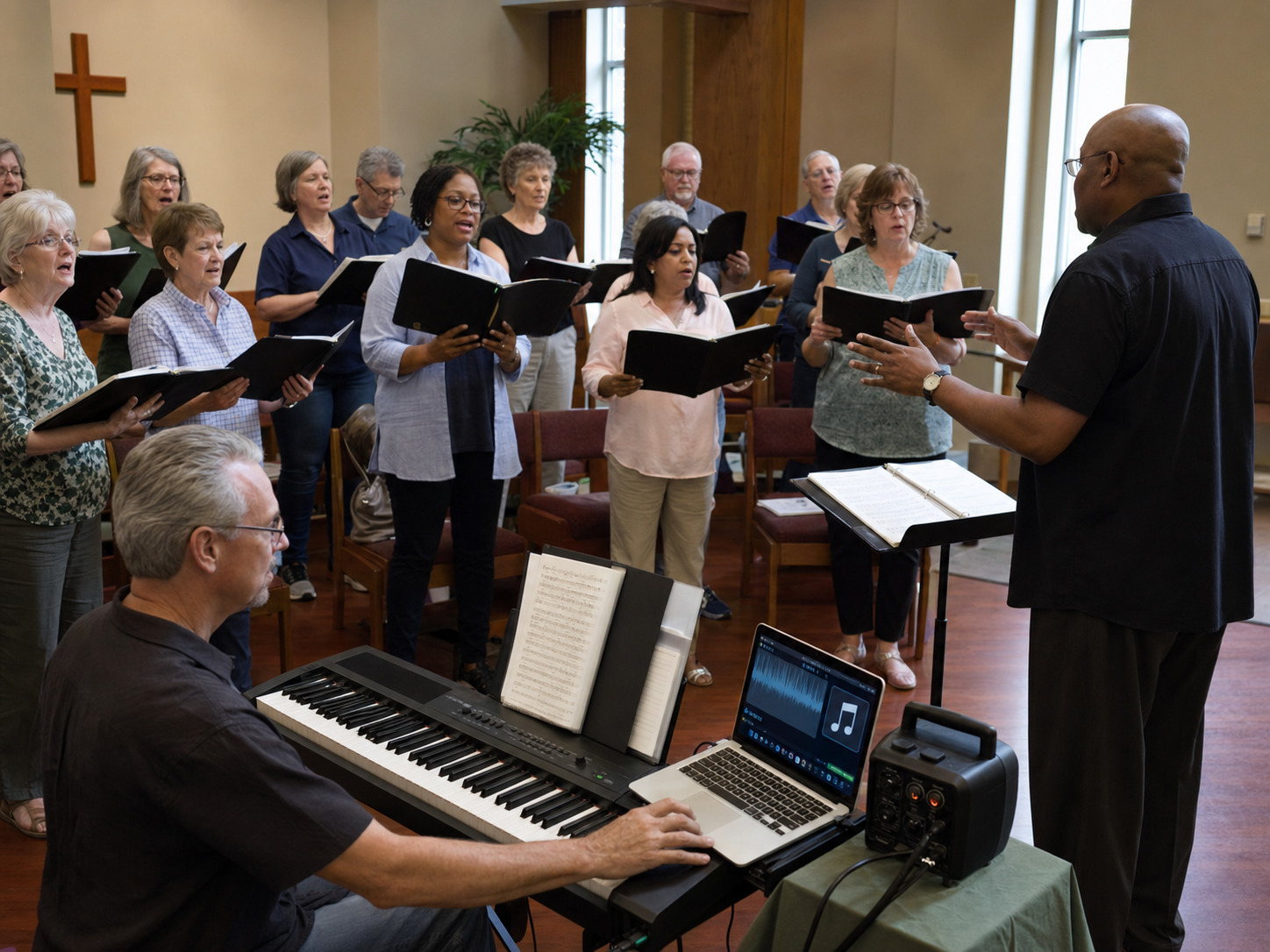
A guide vocal and an accompaniment track do different jobs in choir rehearsal.
Use the guide vocal to teach melody, entrances, words, and phrasing. Use the accompaniment-only file to find out whether the choir can carry those choices without leaning on a recorded singer. The best rehearsal plan moves deliberately from one to the other before the service.
Give each file one clear job
A demonstration guide vocal lets singers hear how the vocal line sits inside the arrangement. It can make a new hymn, an unfamiliar verse, or a difficult entrance easier to study between rehearsals.
An accompaniment track removes that sung example. It gives the choir the instrumental support it will need while requiring the live singers to lead the words, breath, blend, and shape.
Think of the files this way:
| File | Best use | What the director listens for |
|---|---|---|
| Guide vocal | First listen, home practice, text and entrance learning | Correct melody, rhythm, pronunciation, and phrasing |
| Accompaniment only | Choir rehearsal, service transitions, final run, performance | Independent entrances, unified cutoffs, balance, and confidence |
The guide is a teacher. The accompaniment is the test.
Use a four-pass rehearsal plan
The choir does not have to jump from listening to a full performance run. Move through four focused passes.
Pass 1: listen and mark
Play the guide vocal once without asking everyone to sing at full volume. Mark the introduction, first entrance, verse pattern, repeated material, instrumental spaces, and ending.
Ask simple questions:
- How many beats or measures are in the introduction?
- Who carries the first clear entrance?
- Where does the arrangement change from the familiar hymn pattern?
- Does the final verse or ending need a special cutoff?
This pass gives the choir a map before repetition begins.
Pass 2: sing with the guide
Use the guide vocal while the choir learns the melody and text together. Stop at named problems rather than restarting the entire track for every mistake.
For a hymn, the important problems are often practical:
- a pickup before the first full beat,
- a breath that arrives too late,
- consonants that do not release together,
- a verse with different text stress,
- or an ending that does not match the printed page the choir expects.
Let the recorded voice clarify the example, then have the director or section leaders name what the choir should keep.
Pass 3: remove the guide in sections
Switch to the accompaniment-only file before the choir feels completely finished.
Run the introduction and first phrase. Then run the most difficult transition. Then run the ending. If those landmarks hold together without the guide, connect them into a full pass.
If the choir loses an entrance, return to the guide for that one section, identify the cue, and remove the guide again. Do not let the rehearsal drift back into singing along with the entire recorded performance.
Pass 4: rehearse the service moment
Now run more than the song.
Practice the spoken introduction, standing or processional cue, track start, first breath, microphone position, last cutoff, and whatever follows—silence, prayer, a reading, applause, or another song.
The accompaniment file is fixed, but the service still moves through real people and real cues. Rehearse that movement.
Choose the key before phasing out the guide
A guide vocal can make a difficult key feel temporarily safer because another singer is carrying the line. The accompaniment-only pass exposes whether the live choir can sustain the range.
Check the actual singers:
- Are upper voices straining by the final verse?
- Do lower voices lose presence at the bottom of the melody?
- Can the congregation join without dropping out?
- Does the director have to over-sing just to keep the room moving?
The right key is the one the intended singers can use with steadiness. Confirm it before distributing the final rehearsal folder. When a different key is needed, order or prepare that track separately rather than letting the choir memorize a version that will later move.
Keep home practice and Sunday files separate
Create a simple folder for each song:
Song Title - GUIDE - practiceSong Title - ACCOMP - rehearsalSong Title - ACCOMP - Sunday approved
The Sunday folder should contain only the approved accompaniment file. This keeps a volunteer sound operator from opening a guide vocal by mistake and gives the director one version to reference in the service order.
If a track is replaced because of a new key, cut, or ending, archive the old version outside the active folder. Do not leave several files named final and expect a volunteer to know which one the choir last rehearsed.
Use the Classic Hymns Collection as a practical starting set
The Spiritrax Classic Hymns Collection contains 12 accompaniment tracks in commonly sung keys, and each track comes with sheet music. Five selections also include demonstration guide-vocal tracks.
That makes the collection useful for a mixed rehearsal plan:
- use the demonstration files where the choir needs help hearing the vocal line,
- use the accompaniment files to build independent entrances and service readiness,
- and keep the sheet music and playback file on the same title and key.
The collection includes familiar hymns such as Amazing Grace, Be Thou My Vision, Blessed Assurance, Holy, Holy, Holy, The Old Rugged Cross, and What a Friend We Have in Jesus. Because guide vocals are included for five selections rather than all 12, check the product details for the specific hymn before building the rehearsal plan.
Rehearse the operator, too
The choir can know every note and still have a difficult service if the playback cue is unclear.
Give the operator:
- the exact approved filename,
- the order-of-service position,
- who gives the start cue,
- the intended volume,
- any fade or stop note,
- and a backup copy that has been tested.
Run the first ten seconds and the ending through the actual sound system. A calm start and a known ending do more for the room than another unfocused full-song repetition.
Common mistakes to avoid
Leaving the guide vocal on for every rehearsal
The choir may sound secure because it is following the recorded singer. Remove the guide early enough to hear what the live group actually knows.
Removing the guide without naming the cue
If singers miss an entrance, identify what they should listen for in the accompaniment. Repetition without a landmark does not fix the uncertainty.
Changing the key after files are distributed
Choose the working key with the actual choir, then make sure the guide, accompaniment, and sheet music all refer to that version.
Practicing only the middle of the song
The introduction, first entrance, final cutoff, and transition out of the song are the moments most likely to affect the service.
FAQ: guide vocals and choir backing tracks
What is a guide vocal track?
A guide vocal track is a demonstration recording that lets singers hear the vocal line with the accompaniment. It is useful for learning melody, text rhythm, entrances, and phrasing.
Should a choir perform with the guide vocal playing?
Usually, no. Use the guide for learning, then rehearse and perform with the accompaniment-only file so the live choir carries the vocal line.
When should the choir switch to accompaniment only?
Switch while there is still rehearsal time left. Once the choir can identify the form and main entrances, begin testing sections without the guide.
What if the choir falls apart without the guide?
Return to the guide for one named section, find the accompaniment cue, and remove the guide again. Keep the correction focused.
Can one rehearsal use both files?
Yes. A productive rehearsal may listen with the guide, correct a few passages, then spend the rest of the time on the matching accompaniment track.
The takeaway
Guide vocals help a choir learn the line. Accompaniment tracks help the choir own it.
Give each file one job, switch before Sunday, test the actual key, keep the approved performance folder clean, and rehearse the first cue and final cutoff with the sound operator. The result is not simply a choir that knows the notes. It is a service moment the whole team can support.
Start with a practical hymn set: the Classic Hymns Collection includes 12 accompaniment tracks with sheet music, and five selections also include demonstration guide vocals.
Explore the Classic Hymns Collection