
All Saints Sunday Music Should Leave Room for Every Name
Holiday & Special Occasion Music
By Spiritrax Content Studio · July 31, 2026
Updated July 31, 2026
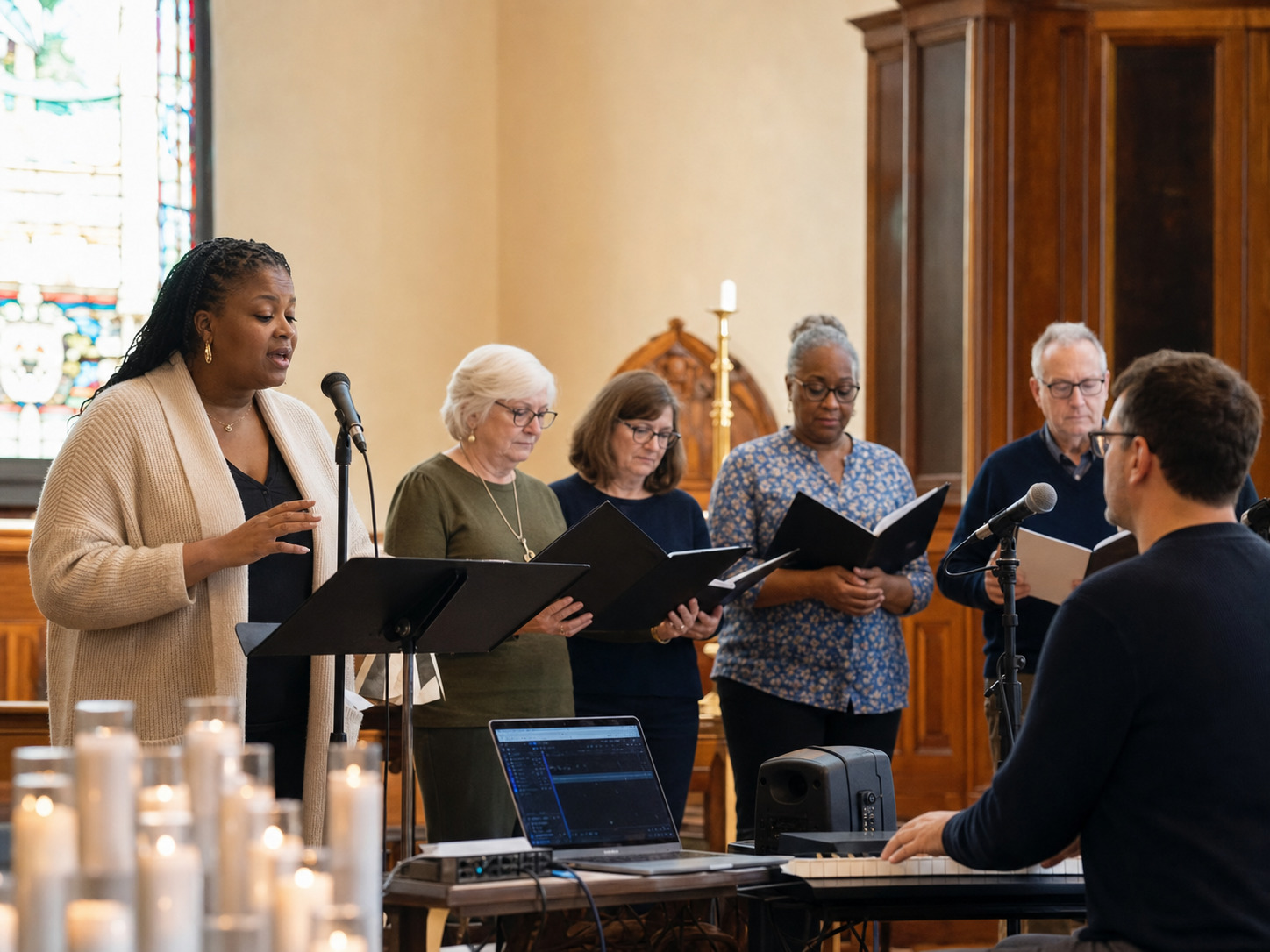
All Saints Sunday asks music to do something delicate: hold memory, grief, gratitude, and hope in the same room. A backing track can support that work, especially when a church has a soloist or small choir but no accompanist available for the service. It should never hurry the remembrance or make the music feel detached from the people being honored.
The best plan begins with the service, not the playlist.
The short answer: how should you plan All Saints Sunday music?
Choose one or two familiar hymns that fit your congregation’s practice, place them around the service’s acts of remembrance, and rehearse the exact keys, verses, cues, and endings in advance. Give silence a defined place. Use accompaniment that supports congregational singing or a soloist without overpowering names, prayers, candle lighting, bells, or spoken memories.
A simple All Saints music plan should answer six questions:
- What is the service remembering or celebrating?
- Who is expected to sing: congregation, choir, soloist, or a combination?
- Which verses will be used?
- What key lets the singers carry the text comfortably?
- Who gives each playback cue?
- What happens after the final note?
Start with the worship leader’s service shape
All Saints observance varies across churches and traditions. Some congregations read names, light candles, ring bells, display photographs, share communion, or invite spoken remembrances. Others keep the service simpler. Confirm the local plan before choosing music, and follow the direction of the pastor, priest, worship leader, or other responsible service planner.
Music can serve several different roles:
| Service moment | Musical job | Backing-track consideration |
|---|---|---|
| Gathering | Establish a calm, communal tone | Keep the level supportive and avoid an abrupt first cue |
| Congregational hymn | Let the room sing together | Choose a comfortable key and a clearly countable introduction |
| Reading of names | Support or frame remembrance | Decide whether music belongs before, after, or quietly around the action |
| Candle lighting or prayer | Leave room for an unhurried ritual | Avoid a fixed musical ending that forces the service to move too quickly |
| Solo or small choir | Offer a focused reflection | Confirm breaths, verses, entrances, and microphone balance |
| Sending | Turn remembrance toward hope and service | Use a clear ending that helps the room know when to move |
The question is not “How many songs can we include?” It is “What does this part of the service need from music?”
Why “For All the Saints” often works
“For All the Saints” gives many congregations a direct connection between remembrance and hope. The hymn can work as a congregational selection, a solo, or a small-choir feature when that choice fits the church’s tradition and service plan.
The Spiritrax “For All the Saints” backing track currently offers accompaniment in G, E, B-flat, and C major. The arrangement uses solo piano and viola and contains four verses. Preview every available key with the actual singer or choir rather than choosing only from the original key.
For a broader group of familiar selections, the Spiritrax Classic Hymns Collection can help a worship planner compare accompaniment options without turning the service into a long song list.
Choose the key for the people in the room
A familiar hymn can still become difficult when the key is chosen for habit instead of the singers. Test the highest sustained phrase, the lowest line, and the final verse after the soloist or choir has already been singing for several minutes.
For congregational use, ask:
- Can most people enter comfortably after the introduction?
- Does the melody sit in a range that invites participation?
- Will older voices or a small group be asked to push?
- Can the leader sing clearly without turning the microphone into the only audible voice?
For a soloist, prioritize text, breath, and emotional steadiness over vocal display. All Saints music often carries personal meaning. A comfortable key gives the singer more room to communicate and less reason to manage strain in a sensitive moment.
Decide the exact verses before rehearsal
Do not assume everyone will sing every verse printed in a hymnal or lyric sheet. The Spiritrax arrangement has four verses, so compare the purchased track, the lyrics your congregation is authorized to use, and the service order before rehearsal.
Write the plan plainly:
- number of verses;
- who sings each verse;
- whether the congregation joins immediately or after a solo opening;
- whether names, candles, or spoken words occur near the music; and
- what the leader does after the final note.
If the service requires a different form, do not improvise an audio edit on Sunday morning. Ask early whether an appropriate custom version can be prepared, and confirm the scope before relying on it.
Protect silence as part of the arrangement
Silence is not a technical failure in an All Saints service. It may be the moment when the room breathes, remembers, or listens for the next name.
The music plan should mark silence intentionally:
- Allow the final chord to settle before the next speaker begins.
- Do not start a track under the reading of names unless the worship leader has chosen that shape deliberately.
- If candles are lit, decide whether the action has a fixed length or needs open time.
- Avoid filling every transition merely because the playback system is ready.
- Give the sound operator a clear “wait” instruction when the cue depends on the room.
Backing tracks are fixed recordings. If an action may take an unpredictable amount of time, it is often better to place the hymn before or after the action rather than forcing the ritual to match a track’s duration.
Rehearse the cue, not just the hymn
A singer who knows the melody can still miss an entrance when the introduction is unfamiliar. A volunteer operator can still start the right file at the wrong moment. Rehearse the entire handoff from speech or prayer into music.
During the sound check, confirm:
- the exact file and key;
- the introduction length and first sung word;
- microphone distance for soloist or choir;
- track volume from the congregation’s seating area;
- whether the room’s acoustics blur the text;
- the final chord and the next spoken or visual action;
- who gives the start cue; and
- what the operator does if the cue is delayed.
Run the transition at least twice. The second pass shows whether the cue is repeatable or was merely lucky.
Keep the sound warm and human
Sanctuaries, chapels, and fellowship rooms change how an accompaniment feels. A track that sounds balanced on headphones may become boomy through a floor speaker or too bright through a wall-mounted system.
Listen from several places in the room. Keep the accompaniment loud enough to provide pitch and musical confidence but quiet enough for the congregation, soloist, or choir to remain the human center of the sound.
If the service is livestreamed or recorded, confirm the church’s own audio routing and any permissions that apply. Buying a backing track does not automatically grant every possible media use. Review the Spiritrax licensing information and ask for help when the planned use is unclear.
A calm rehearsal timeline
Two to four weeks before the service
- Confirm the service shape and music selections.
- Preview the available keys with the actual singers.
- Purchase or obtain the approved accompaniment.
- Decide verses, leaders, and congregational participation.
- Ask about any needed customization early.
One week before the service
- Rehearse with the exact accompaniment file.
- Confirm introductions, breaths, verses, and ending.
- Share the filename and cue notes with the operator.
- Test the playback device and speaker path.
Before people arrive
- Open only the final file on the performance device.
- Silence notifications and disable sleep or automatic updates.
- Check microphones and track level in the room.
- Run the spoken-to-musical cue once.
- Keep a tested backup copy available to the responsible operator.
All Saints Sunday music checklist
- The music fits the congregation’s tradition and the approved service plan.
- The soloist, choir, or congregation can sing the chosen key comfortably.
- The exact verses and order are documented.
- The reading of names, candles, bells, prayers, and silence have enough time.
- The operator knows the precise start cue and what follows the ending.
- The final track has been tested through the actual sound system.
- The room has a backup playback plan.
- Livestream, recording, and other uses have been checked separately.
FAQ: All Saints Sunday music and backing tracks
Is “For All the Saints” suitable for congregational singing?
It can be when the hymn fits the congregation’s tradition, the selected verses are clear, and the key supports the people expected to sing. Preview the introduction and available keys with the worship leader before the service.
Can a small choir use a backing track?
Yes. A backing track can give a small choir steady accompaniment when a live accompanist is unavailable. The choir still needs a leader, a clear entrance plan, balanced microphones where used, and rehearsal with the exact file.
Should music play while names are read?
Only when the worship leader intentionally chooses that structure. A fixed recording can compete with names or hurry an unpredictable remembrance. Silence, a hymn before the reading, or music after it may serve the moment better.
Can the track be shortened or moved to another key?
The Spiritrax product page offers several ready-made keys and a customization path. If the service needs a different key, length, verse plan, lead-in, or ending, ask early and confirm that the requested change can be supported before building the service around it.
Let the music hold the room gently
All Saints music does not need to carry every feeling by itself. It needs to give people a reliable place to sing, remember, and hope together.
Choose fewer pieces with care, rehearse the real transitions, protect silence, and let the accompaniment support the people in the room. A calm plan will do more for the service than a crowded playlist ever could.
Preview “For All the Saints” in four available keys, then choose the accompaniment that best supports your soloist, small choir, or congregation and the exact shape of the service.
Preview For All the Saints